
If you are weighing up kikuyu vs buffalo for a Perth lawn, the answer depends on sun, shade and how hard the lawn will be used. From the sources we checked, buffalo is the better fit for most home lawns on Perth sand, especially where the yard gets some shade or kids and pets use the lawn. Kikuyu suits full sun and heavy wear, but it needs more edging and mowing to keep it out of the garden beds. Couch is the grass we know least about from the research, and it needs more fertiliser than buffalo. For the full picture, read our complete guide to lawn in Perth.
What the Perth trials found
The most direct local evidence we found is a three-year trial run by the University of Western Australia’s Faculty of Agriculture at the Shenton Park Turf Water Use Research Facility. The Water Corporation was the principal sponsor. The trial tested 11 common turf varieties across 180 plots, and the results were announced in May 2000. The Government statement says buffalo and couch varieties such as Santa Anna were best suited to Perth’s climate, and that the best performer stayed healthy on a 10 mm drink every second day.
Kikuyu was one of the 11 varieties tested, but the statement does not say how it performed. Because the trial is more than 25 years old, treat it as a starting point rather than the final word.
The Department of Primary Industries and Regional Development (DPIRD) adds that the warm-season types, including couch, buffalo, paspalum, zoysia and kikuyu, are the most common grasses in WA home gardens. It also warns that many warm-season varieties are less adapted to shade and may turn brown in winter.
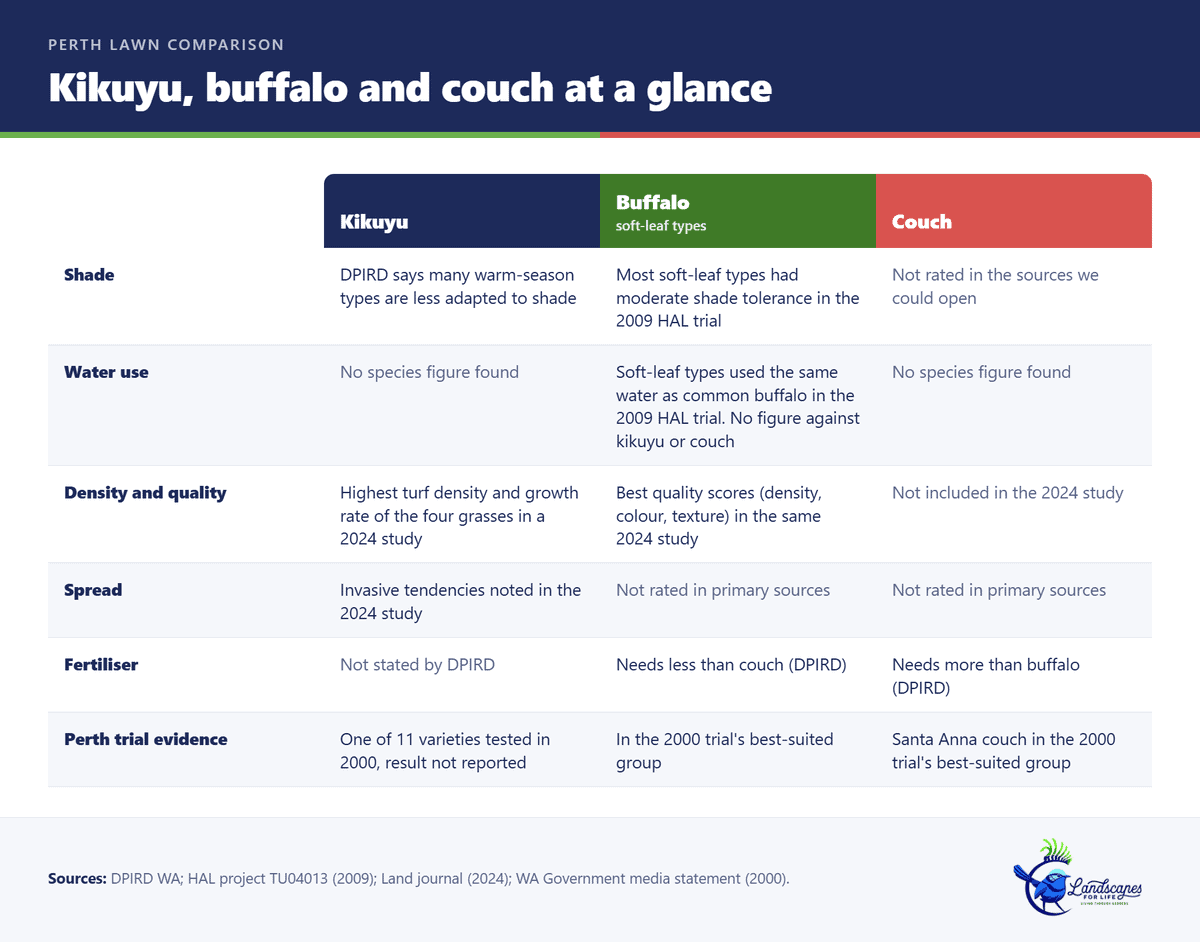
Kikuyu, buffalo and couch at a glance
| Kikuyu | Buffalo (soft-leaf types) | Couch | |
|---|---|---|---|
| Shade | DPIRD says many warm-season types are less adapted to shade | Most soft-leaf types had moderate shade tolerance in the 2009 HAL trial | Not rated in the sources we could open |
| Water use | No species figure found | Soft-leaf types used the same water as common buffalo in the 2009 HAL trial. No figure against kikuyu or couch | No species figure found |
| Density and quality | Highest turf density and growth rate of the four grasses in a 2024 study | Best quality scores (density, colour, texture) in the same 2024 study | Not included in the 2024 study |
| Spread | Invasive tendencies noted in the 2024 study | Not rated in primary sources | Not rated in primary sources |
| Fertiliser | Not stated by DPIRD | Needs less than couch (DPIRD) | Needs more than buffalo (DPIRD) |
| Perth trial evidence | One of 11 varieties tested in 2000, result not reported | In the 2000 trial’s best-suited group | Santa Anna couch in the 2000 trial’s best-suited group |
The 2024 study compared kikuyu, bermuda grass, buffalo and tall fescue. It did not include couch, so the table has no quality score for couch.
Kikuyu: the sun lawn that needs managing
Kikuyu had the highest turf density, weed-control potential and growth rate of the grasses in the 2024 study, but the authors also noted that it showed invasive tendencies. Plan for that from the start.
Turf suppliers say kikuyu thrives in full sun and regenerates quickly after wear. MyHomeTurf also says Kenda kikuyu handles large dogs and active kids. Those are supplier claims, so check them with a turf grower before buying.
The trade-off is maintenance. MyHomeTurf suggests kikuyu needs mowing every 7 to 10 days in warm months and every 3 to 6 weeks in cold months. If you have garden beds close to the lawn, plan a proper edge before you lay it, because the invasive tendency is what makes it creep.
Buffalo: the shade and low-water option
The 2009 Horticulture Australia project tested 19 soft-leaf buffalo cultivars alongside green couch and kikuyu. It measured shade tolerance, water use and wear. The report summary says that the soft-leaf buffalo types tested “do not differ in water use when compared to old-style common buffalo grass”, and that most types had moderate shade tolerance and wore reasonably well with good recovery.
Two limits matter here. The summary does not give a water figure for buffalo against kikuyu or couch, so we cannot say from the research that buffalo uses less water than the other two. The same report also says the impact of wear in a shaded area was not tested, so the shade result is for light shade, not heavy shade.
Buffalo also scored best on quality measures in the 2024 study, which tested density, colour, texture and coverage. MyHomeTurf recommends mowing buffalo at 2 to 5 cm in sun or light shade, and 5 to 7 cm in heavier shade. That is supplier advice, not a trial result.
Couch: the grass we know least about
Santa Anna couch was among the best-suited turf types in the 2000 Perth trial, and DPIRD notes that couch needs more fertiliser than buffalo. We could not find a species-level water figure for couch, and it was not part of the 2024 study. If you are set on couch, ask a turf grower for a sample and their Perth trial data before you order.
Watering a Perth lawn on the roster
Your watering roster is set by your street number, not your suburb. The Water Corporation says that for properties spanning several numbers, you use the higher number, and that unit numbers are ignored. Lot numbers apply only where there is no street number. Water once on your roster day, before 9am or after 6pm. Garden bore users in Perth and Mandurah follow the same roster and times as scheme users, and the on-the-spot fine for breaching it is $100.
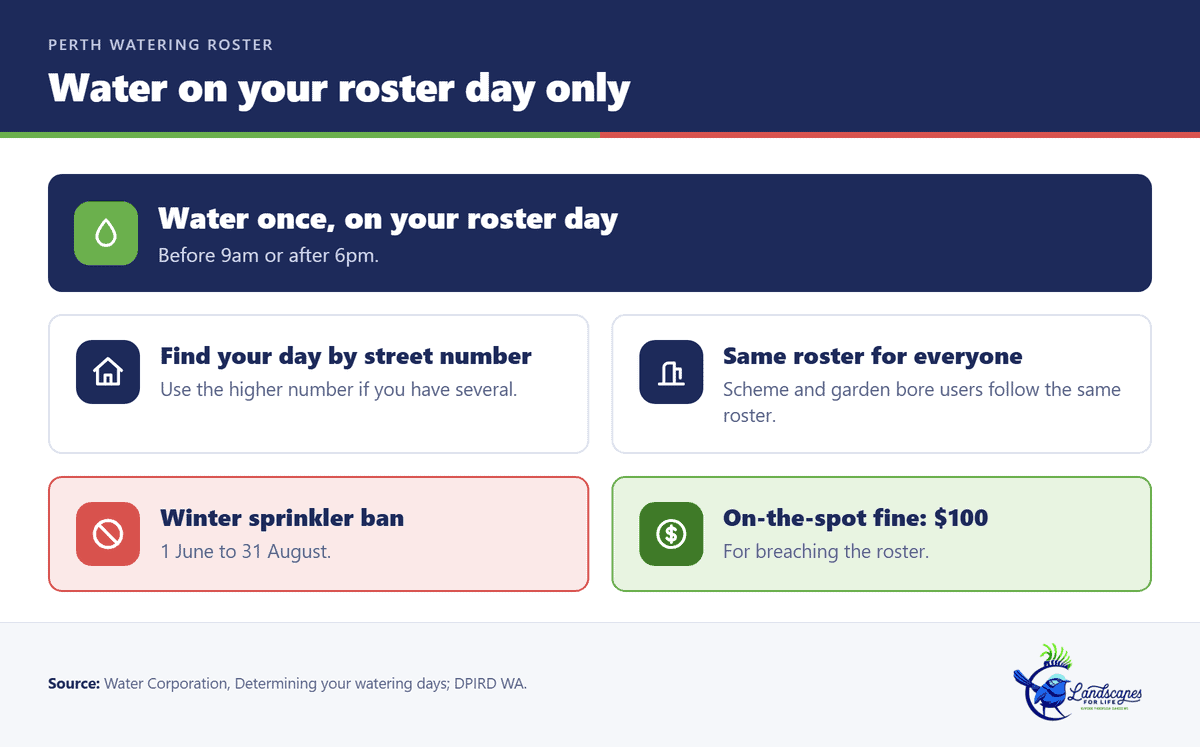
The winter sprinkler ban runs from 1 June to 31 August, according to DPIRD. Our trial reference point, 10 mm every second day, is a trial regime and not a rule, so follow your roster.
Fertiliser on Perth sand
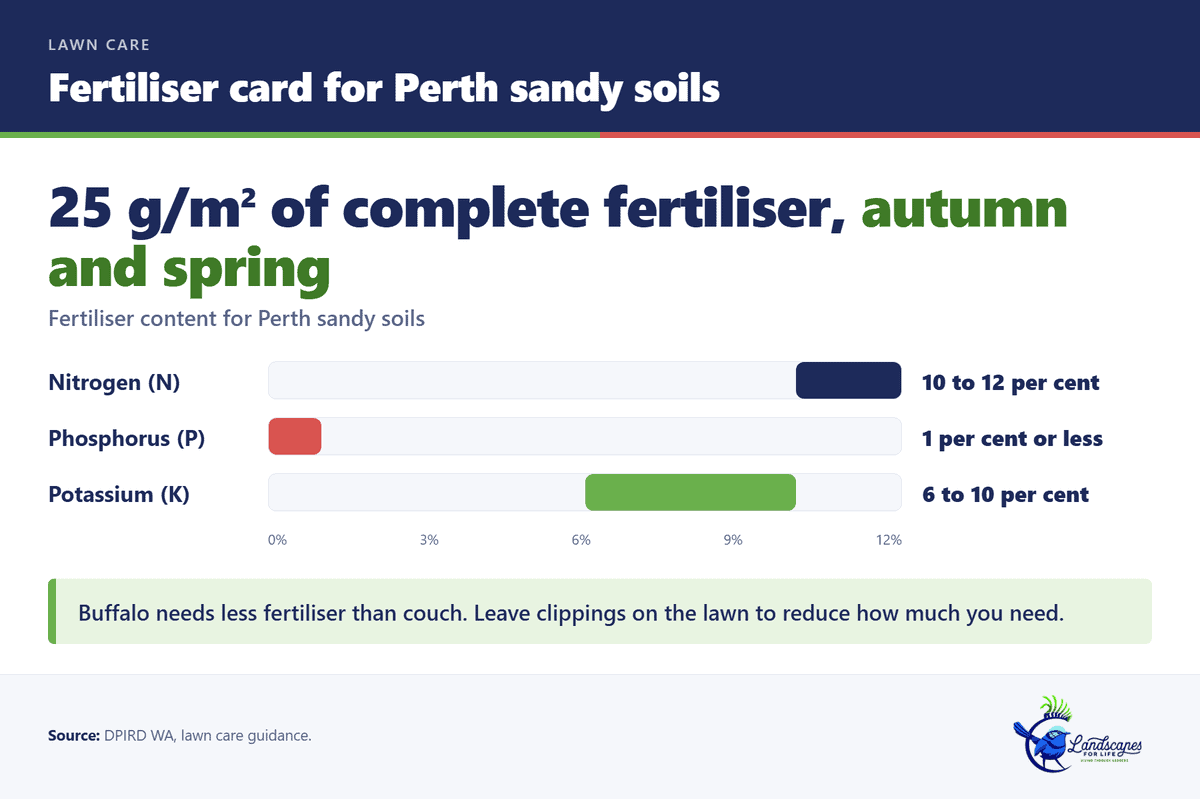
DPIRD’s guidance is written for Perth sandy soils specifically. It recommends about 25 g/m2 of a complete fertiliser with 10 to 12 per cent nitrogen, 1 per cent or less phosphorus and 6 to 10 per cent potassium. Apply it in autumn and spring, when the grass is growing fastest. Buffalo needs less than couch.
Leaving clippings on the lawn cuts how much fertiliser you need. DPIRD also suggests a complete fertiliser without phosphorus, because phosphorus running off into waterways is a problem in Perth.
Which lawn to choose
- Full sun, heavy use, and you will edge and mow often: kikuyu.
- Some shade, kids or pets, and less mowing: buffalo, with a soil test and a turf grower’s advice on the soft-leaf variety.
- Full sun, and you are prepared to feed it more: couch, but only after you have seen a sample on a Perth lawn.
- Not sure: test your soil, look at how much sun the block gets in a typical summer day, and ask a turf grower to show you the varieties in person.
Buffalo is the grass most of the sources we read recommend for shade and low maintenance. Most of those sources sell turf, though, so the recommendation is strongest where it matches the research: shade and low-maintenance use.
Frequently asked questions
What is the best lawn for Perth?
There is no single best lawn for every block. Buffalo suits most home lawns with some shade and family use, kikuyu suits full sun and heavy wear, and couch suits full sun if you are prepared to feed it more. Match the grass to your sun, shade and use first.
Does buffalo grass cope with shade in Perth?
Most soft-leaf buffalo types had moderate shade tolerance in the 2009 HAL trial. That trial did not test wear in shade, so plan for light shade rather than deep shade.
Is kikuyu invasive?
The 2024 study noted that kikuyu showed invasive tendencies. In practice that means it creeps into garden beds and paths unless you edge it and keep it mown.
Does couch need more fertiliser than buffalo?
Yes. DPIRD says buffalo needs less fertiliser than couch.
How much water does a Perth lawn need?
We could not find a verified water figure for each grass species on Perth sand. Start with your Water Corporation roster, water once on your roster day, and adjust from there.
We offer lawn installation Perth, including turf and synthetic turf, and soil rejuvenation for Perth’s sandy soil. For ongoing care, see our lawn care Perth page. Ready to choose? Get a free quote and tell us about your lawn.