
Lawn installation in Perth looks simple from the street. Order some turf, roll it out, add water. In practice the sandy soil, the two-day sprinkler roster and a long hot summer decide whether a new lawn thrives or struggles.
This guide covers the lot: which grass suits which yard, how turf is laid, a month-by-month care calendar, and an honest look at real lawn against artificial grass. We are Landscapes For Life, a family-owned landscaping and garden maintenance company working across the Perth metro area since 2009. Where we could not verify a fact, we say so.
In this guide
- The short answer
- Why lawn in Perth plays by different rules
- Choosing a lawn: kikuyu, buffalo, couch and zoysia
- Lawn installation in Perth: how roll-on lawn is laid
- Watering a new lawn under the roster
- The Perth lawn care calendar, month by month
- Artificial grass in Perth: the honest comparison
- How to choose: a simple decision guide
- Frequently asked questions
The short answer
- Sunny, hard-wearing yard: kikuyu is the usual pick. It needs at least 5 to 6 hours of sun a day.
- Part shade or a softer feel: soft-leaf buffalo copes with 3 to 4 hours of sun, and research found it more shade tolerant than the other warm-season grasses.
- Lawn installation: the laying is the quick part. The soil preparation, the levels and the new-lawn watering exemption decide whether it roots well.
- Watering: Perth lawns get two rostered days a week and a full sprinkler switch-off from 1 June to 31 August. Water Corporation says 10 mm, twice a week in summer, is enough.
- Synthetic: it costs more upfront in the published ranges, and research measured it far hotter than real lawn on summer days.
Why lawn in Perth plays by different rules
Our summers are hot and dry, and our winters are cool and wet. Our soil is mostly sand on the coastal plain and clay in the hills. A lawn that suits Melbourne or Brisbane can struggle here.
The biggest rule is the sprinkler roster. From 1 September to 31 May you can run sprinklers on two days a week, once a day, before 9am or after 6pm. Your days are set by the last digit of your house number (WA Government).
From 1 June to 31 August there is a full switch-off. Hand watering is still allowed, and a breach can cost a $100 fine (WA Government).
The good news is that a lawn needs less water than most people think. Water Corporation says Perth gardens and lawns need 10 mm of water, twice a week in summer, and that more gives no extra benefit (Water Corporation).
Sand adds its own problems. The WA Department of Water notes that many WA soils are short of nitrogen and phosphorus, and that wetting agents may help where soil repels water (Department of Water). Slow-release fertiliser is preferred because nutrients leach out of the root zone on sand, which is why local fertiliser advice is strict.
Lawn is also a big part of our city. In 2000 the WA Government said Perth had about 15,000 hectares of lawn, with about 7,000 hectares irrigated from scheme water. That figure is old, but it shows why the roster exists.
Choosing a lawn: kikuyu, buffalo, couch and zoysia
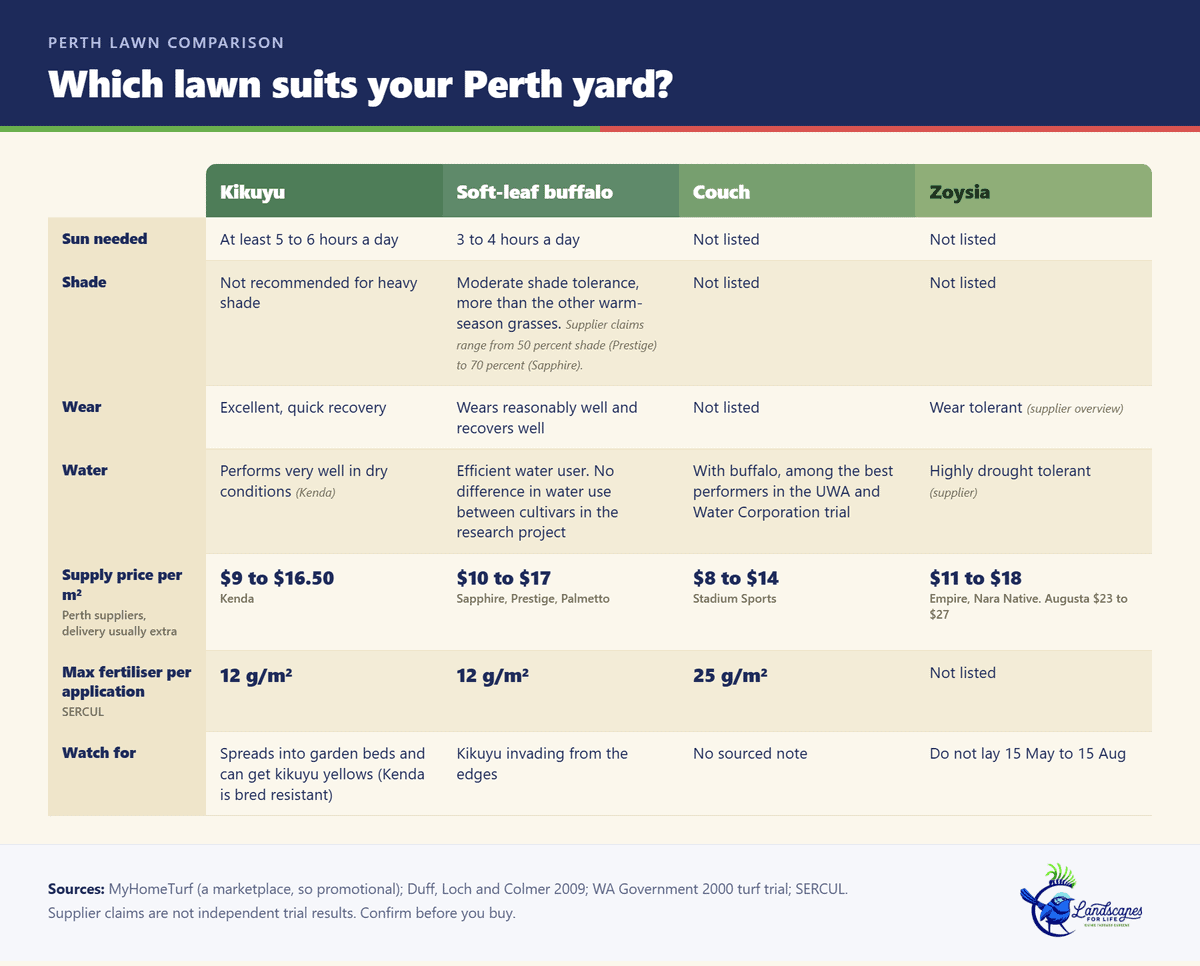
Four warm-season grasses cover almost every Perth yard. The right one depends on sun, traffic, budget and how much mowing you want. For a deeper side-by-side, read our guide to the best lawn for Perth.
A word on evidence first. A three-year trial at Shenton Park, run by the University of Western Australia with Water Corporation as sponsor, tested 11 turf types across 180 plots.
Buffalo and couch types, such as Santa Anna, suited Perth best, and the best performer stayed healthy on 10 mm of water every second day (WA Government, 2000). It is older research, and the shade data below comes from later work.
Kikuyu: the tough, sun-loving all-rounder
Kikuyu is among the hardiest lawns for wear, and it recovers quickly. It needs at least 5 to 6 hours of sun a day and is not recommended for heavily shaded gardens (MyHomeTurf).
Its weakness is its energy. Kikuyu spreads by stems and roots and can invade garden beds. The Kenda variety spreads less, and is bred to resist kikuyu yellows, a root rot disease.
Perth supplier pricing is about $9 to $16.50 per square metre for Kenda, before delivery (MyHomeTurf). Mowing runs every 7 to 10 days in warm months and every 3 to 6 weeks in cool months (MyHomeTurf).
Buffalo: the shade-friendly, softer option
Soft-leaf buffalo copes with as little as 3 to 4 hours of sun a day. A national research project on 19 soft-leaf buffalo cultivars, with trial sites in WA and four other jurisdictions, found them more shade and wear tolerant than other warm-season grasses, with moderate shade tolerance overall (Duff, Loch and Colmer, 2009).
The same project found no measurable difference in water use between cultivars. Soft-leaf types are efficient water users and recover after dry spells. Buffalo also grows more slowly than kikuyu, and is non-invasive according to one supplier marketplace.
Suppliers make bigger shade claims, from 50 percent shade for Prestige to 70 percent for Sapphire. Treat those as sales claims, not trial results. Buffalo costs about $10 to $17 per square metre in the Perth supplier listings.
Couch: the budget lawn
Couch is the cheapest of the four, with Stadium Sports couch listed at $8 to $14 per square metre. It has a finer leaf and, in the Shenton Park trial, couch types sat alongside buffalo among the best performers.
Couch needs sun and regular feeding. SERCUL’s sandy-soil guide allows up to 25 g/m² per fertiliser application for couch, against 12 g/m² for kikuyu and buffalo (SERCUL). We could not find a sourced shade rating for couch, so ask your grower.
Zoysia: slow, drought tough and pricey
Zoysia is highly drought tolerant according to suppliers, and Empire zoysia is described as performing well in both sandy and clay soils (MyHomeTurf). It mows less often, about every two weeks in warm months. Do not lay zoysia between 15 May and 15 August (MyHomeTurf).
Price is the catch. Empire and Nara Native sit at $11 to $18 per square metre, and Augusta is listed at $23 to $27.
Kikuyu vs buffalo: the quick rule
If you are weighing kikuyu vs buffalo vs couch, use sun hours as the first filter.
- Under 4 hours of direct sun: buffalo.
- Full sun and kids, dogs or cricket: kikuyu.
- Tight budget and a sunny yard: couch or kikuyu.
- Low mowing appetite: buffalo, because it grows more slowly.
One warning on mixing. Kikuyu spreads fast and can invade other lawns and beds, so a buffalo lawn next to kikuyu needs a watchful eye on the edges.
Lawn installation in Perth: how roll-on lawn is laid
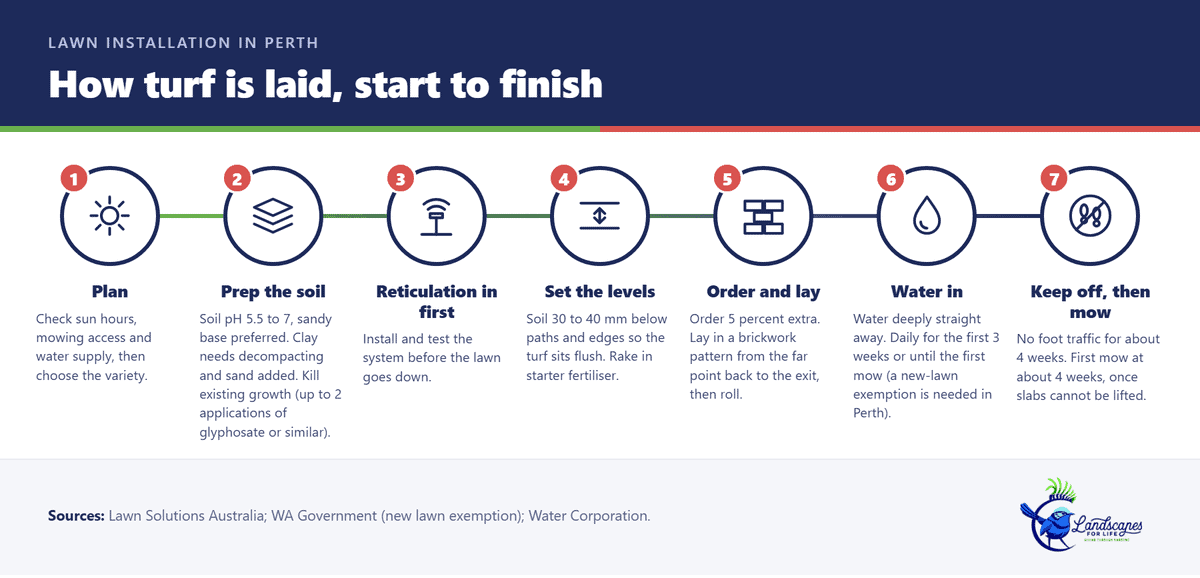
Good lawn installation Perth work is mostly preparation. The laying is the quick part. The preparation before it decides how well it roots.
Here is the order we recommend for lawn installation, built on published turf-industry guidance and local rules.
1. Plan and prepare the soil
Check the sun hours, how the mower will reach the lawn and where the water comes from. Lay the turf last, so no one walks on it while other work is going on.
We also offer soil rejuvenation for Perth’s sandy soil. Aim for a soil pH of 5.5 to 7. A sandy base is preferred, and clay needs decompacting with sand added (Lawn Solutions Australia). Kill old growth first, which can take up to two applications of glyphosate or similar.
2. Get the reticulation right first
An automatic system should go in before the lawn. Water Corporation allows installation and testing of irrigation using the minimum water needed, with tests limited to 2 minutes per station and a sign saying authorised sprinkler testing is in progress (Water Corporation).
We install reticulation, so if you are planning both jobs, talk to us about reticulation before you lay lawn.
3. Set the levels
Keep the soil 30 to 40 mm below any path, paving or edge the lawn will meet. That gap lets the turf sit flush once it is down. Rake in a starter fertiliser, then level.
4. Order and lay
Add 5 percent to your measured area to allow for cutting around obstacles. Most farms deliver the next day, so order for a day you can lay.
Start at the point furthest from your exit and lay in a brickwork pattern, working back so you never walk on fresh turf. Roll it once it is down, then water deeply straight away.
5. Keep off, then mow
Keep foot traffic off for about four weeks, depending on the season. The first mow comes at about four weeks, once the slabs cannot be lifted. Mow high first, then lower the blades over the next two or three cuts (Lawn Solutions Australia).
When to lay
Lawn installation can happen in most months. MyHomeTurf notes that buffalo and kikuyu can be installed any time, but that winter laying is slower because the soil is cooler (MyHomeTurf). Zoysia is the exception, with the 15 May to 15 August no-lay window.
If you would rather leave it to us, our turf installation Perth page has the details.
What lawn installation costs
Published Perth cost ranges for lawn installation vary. One Perth guide puts supply and lay at $26 to $42 per square metre for Sir Walter buffalo and $16 to $28 for kikuyu, plus $500 to $800 extra soil preparation in sandy suburbs (What’s The Damage). That guide is a secondary source, so treat the numbers as a guide and ask for itemised quotes.
Supply alone is much cheaper. Perth supplier listings run $8 to $18 per square metre for the common varieties, before delivery.
Watering a new lawn under the roster
New turf wants water every day for the first three weeks, or until the first mow. The Perth roster allows two days a week. That gap catches people out.
There is no automatic exemption. Under the Water Agencies (Water Use) By-laws 2010, you need a temporary exemption to water a new lawn outside rostered days or between 9am and 6pm.
You can apply online if you have a Water Corporation account, or call the Department of Water and Environmental Regulation on 1800 508 885 (WA Government). An unregistered new lawn with a proven breach can draw the $100 fine.
Do not skip it. Ask for the exemption the same week you book the lawn.
Once the lawn is rooted, drop back to the roster and the 10 mm rule. Different sprinklers deliver different amounts per minute, so measure what your system puts out rather than guessing.
What does water cost? Perth households pay $2.108 per kilolitre for the first 150 kL a year, $2.809 for 151 to 500 kL, and $5.256 above that (2026-27, Water Corporation).
For a 100 m² lawn, one 10 mm session is 1,000 litres, or 1 kL. Even at a ceiling of 78 full sessions a year (two a week from 1 September to 31 May), that is 78 kL, or about $164 to $219 a year. In practice it is lower, because Water Corporation says gardens need far less water in cooler months.
The Perth lawn care calendar, month by month
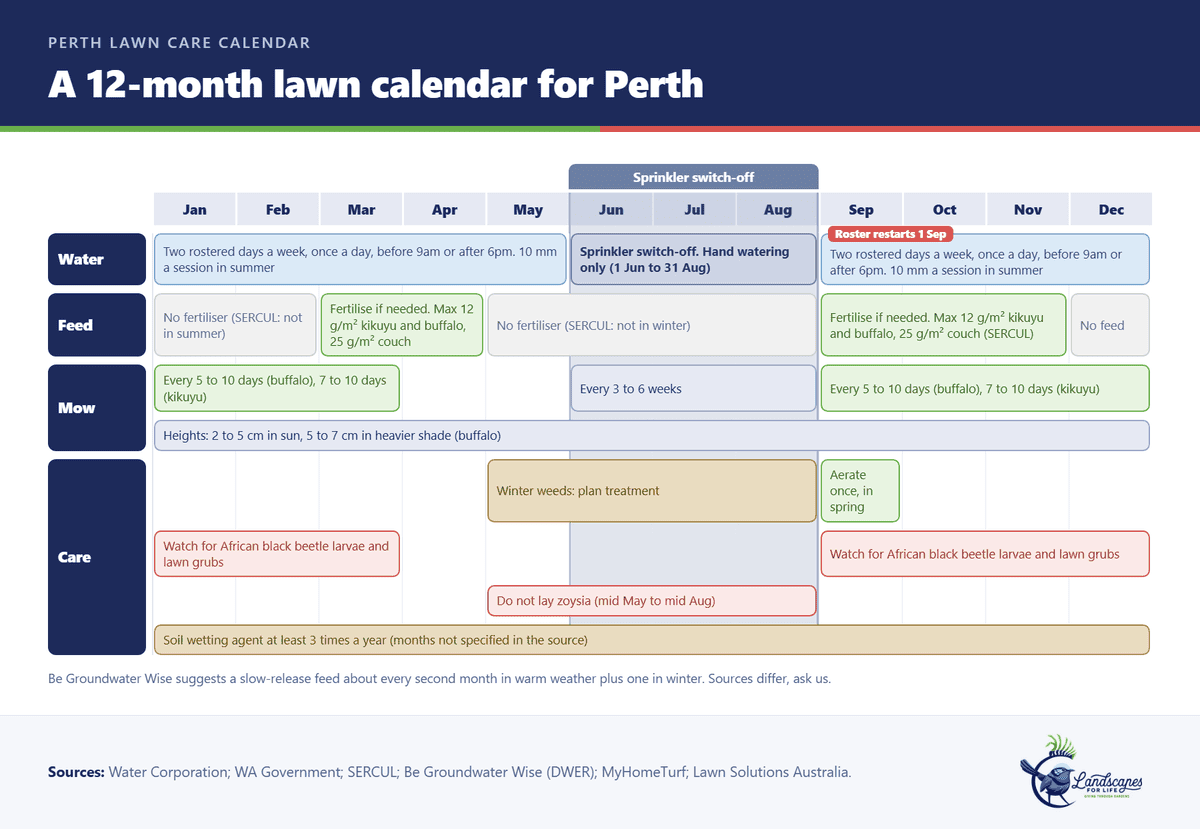
Lawns do not need much, but they need the right thing at the right time. Here is the year in Perth terms. For the full version, see our Perth lawn care calendar.
Summer: December to February
Stick to the roster and the 10 mm rule, and water before 9am where you can. Mow often, about every 5 to 10 days for buffalo and 7 to 10 for kikuyu. Skip the fertiliser, because the SERCUL guide says not to feed in summer or winter.
Watch for lawn grubs. African black beetle larvae feed on roots, and one turf supplier says to watch closely from about September to March and after heavy rain (Lawn Solutions Australia). Dry, straw-like patches that peel back from the soil are the sign.
Autumn: March to May
March and April are one of two feeding windows. SERCUL says to fertilise only if the lawn needs it, in spring or early autumn (September, October, November, March and April). Use a complete lawn fertiliser at a 10:1:6 NPK ratio, and stay under 12 g/m² per application for kikuyu and buffalo (SERCUL).
Winter: June to August
The sprinkler switch-off runs from 1 June to 31 August. Lawns grow slowly, so mow only every 3 to 6 weeks. Hand watering with a hose is still allowed.
Sources differ on winter feeding. SERCUL says do not fertilise, while the Be Groundwater Wise site suggests one slow-release application in winter (Be Groundwater Wise). If your lawn is healthy and green, we lean towards the more cautious local advice.
Spring: September to November
The roster returns on 1 September. This is the time to aerate, once a year, and feed if needed. A Perth lawn service describes spring as the prime time to core aerate, because the lawn is actively growing and fills the holes with new roots (Premier Lawns).
Be Groundwater Wise also recommends a soil wetting agent at least three times a year. Its page does not say which months, so ask a turf grower what suits your soil.
If you would rather we handled the mowing, see our lawn mowing and lawn care Perth service.
A note on top dressing. We could not find a Perth-specific source for the depth or timing of a sand top dressing, so we do not give one here.
Artificial grass in Perth: the honest comparison
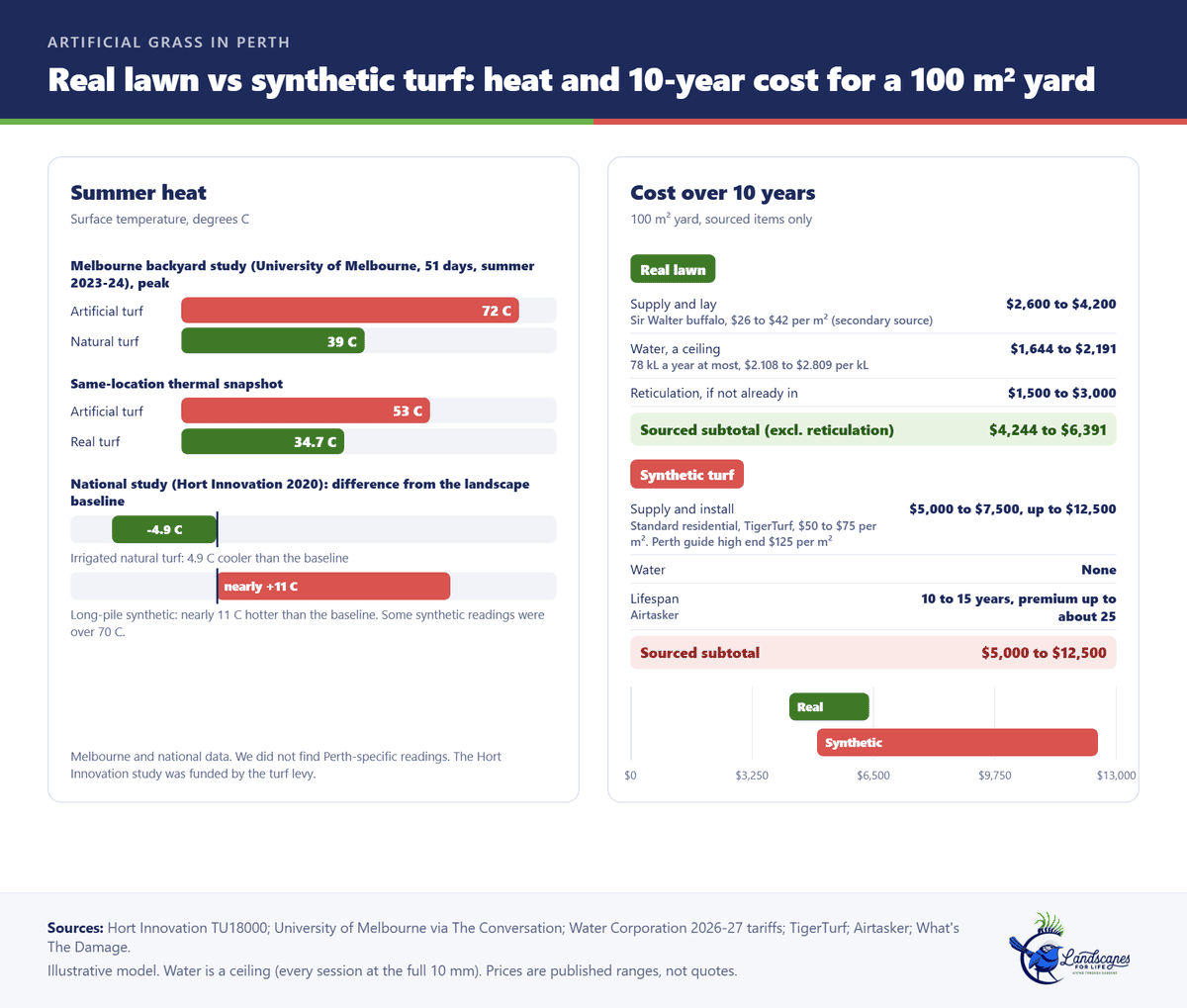
Artificial grass in Perth has plenty of fans. It needs no mowing and no watering, and it stays green all year. Before you decide, look at the heat, the plastic and the 10-year cost.
Heat
The strongest evidence is Australian. University of Melbourne researchers Pui Kwan Cheung and Stephen Livesley measured a suburban backyard over 51 days in summer 2023-24. Artificial turf peaked at 72°C, while real turf never passed 39°C. In one same-spot snapshot, the real turf read 34.7°C and the artificial 53°C (The Conversation).
They report artificial turf was hot enough to cause irreversible burns in adults for almost four hours a day. Their advice was to avoid artificial turf in backyards and to water lawns through summer.
A national study agrees on direction. Hort Innovation’s 2020 report found irrigated natural turf was 4.9°C cooler than the landscape average, while long-pile synthetic turf was nearly 11°C hotter, and some readings topped 70°C (Hort Innovation).
Two honest caveats. The Melbourne data is not from Perth, and the Hort Innovation study was funded by the turf grower levy.
Council positions
The City of Cockburn does not support synthetic turf across a whole verge. It cites heat, extra runoff and harm to soil life, and its policy requires approval where more than 25 percent of a verge is paved (City of Cockburn, 2024).
On microplastics, we found no WA council policy. In NSW, Queanbeyan-Palerang Council’s draft policy of October 2025 recognises that artificial grass may contain microplastics and PFAS, and would restrict it on verges. It would not ban existing installations (QPRC).
Turf Australia, which represents growers, calls synthetic turf a growing environmental threat. That is an industry view, so weigh it as one (Turf Australia).
Ten-year cost for a 100 m² yard
The table below uses only sourced figures. Missing items are marked rather than guessed.
| Item | Real lawn | Synthetic turf |
|---|---|---|
| Supply and install | $2,600 to $4,200 (buffalo, $26 to $42/m²) | $5,000 to $7,500 (standard residential) up to $12,500 (Perth guide, high end) |
| Water over 10 years | up to $1,644 to $2,191 (ceiling) | none |
| Mowing and fertiliser | not costed (no sourced figure) | none |
| Lifespan | ongoing | 10 to 15 years (premium up to about 25) |
| End-of-life removal | none | not costed (no sourced figure) |
| Sourced subtotal | $4,244 to $6,391 | $5,000 to $12,500 |
Sources: What’s The Damage, TigerTurf, Airtasker and Water Corporation tariffs. TigerTurf sells synthetic turf, so its prices come from a seller.
The takeaway: on these numbers the 10-year gap is smaller than the “no more water bills” pitch suggests, because water for a lawn is a small cost. The real differences are the mowing time or fees, and the heat.
Our view
We install both. We lay synthetic turf installation Perth jobs when a customer wants one, and we will tell you plainly what we think. For a big sunny backyard, we would lean towards real lawn on the heat evidence alone. If you want synthetic, keep it small and give it shade.
How to choose: a simple decision guide
- Lots of shade: soft-leaf buffalo.
- Sunny, busy family yard: kikuyu, accepting the extra mowing.
- Low budget: couch or kikuyu.
- A small hot spot where lawn will not grow and you can shade it: consider synthetic, and keep it small.
- Unsure: get an itemised quote for the lawn installation, then compare the sun hours, not the brochure.
Frequently asked questions
What is the best lawn for Perth?
It depends on sun. Soft-leaf buffalo suits part shade and needs 3 to 4 hours of sun. Kikuyu suits sunny, high-wear yards and needs 5 to 6 hours. Couch is the cheapest option for a sunny yard. A WA trial at Shenton Park found buffalo and couch types best suited to Perth’s climate.
When should I fertilise, top dress or aerate my lawn in Perth?
Fertilise only if the lawn needs it, in September to November or March to April, with a lawn fertiliser at a 10:1:6 NPK ratio and a maximum of 12 g/m² for kikuyu and buffalo. Aerate once a year in spring. Be Groundwater Wise suggests a wetting agent at least three times a year. The sources we found do not give a top dressing timing or depth, so ask a turf grower.
How long until I can walk on new roll-on lawn?
Keep foot traffic off for about four weeks, depending on the season. The first mow comes at roughly the same time, once the slabs cannot be lifted by hand.
Do I need a watering exemption for a new lawn in Perth?
Yes. There is no automatic exemption for new lawns under the Water Agencies (Water Use) By-laws 2010. You need a temporary exemption to water outside rostered days or between 9am and 6pm, and a proven breach can mean a $100 fine.
Is artificial grass cheaper than real lawn in Perth?
Not on the published numbers. Supply and install for synthetic runs about $5,000 to $12,500 for 100 m², against about $2,600 to $4,200 for buffalo. Real lawn adds water of up to about $164 to $219 a year, plus mowing and fertiliser, so the costs narrow over 10 years.
Ready for a lawn that suits your yard?
If you are planning lawn installation in Perth, get a free quote and tell us about your yard.
Sources
- WA Government: Winter sprinkler switch-off
- WA Government: Check garden bore water restrictions
- Water Corporation: Watering your garden
- Water Corporation: Water use charges 2026-27
- Water Corporation: Watering exemptions for businesses
- WA Government: Turf trials tell which lawns are best for a dry climate (2000)
- Duff, Loch and Colmer (2009) buffalograss project TU04013
- SERCUL: Fertilise Wise
- Department of Water: Fertiliser application on pasture or turf (2010)
- Be Groundwater Wise: Waterwise gardens, lawns and verges
- MyHomeTurf: Lawn care for Perth’s climate, best grass for Perth, kikuyu vs buffalo and Perth supplier prices
- Lawn Solutions Australia: Laying turf and African black beetle
- Premier Lawns: Core aeration in Perth
- Hort Innovation TU18000 (2020)
- The Conversation: Cheung and Livesley, University of Melbourne
- City of Cockburn: Synthetic turf on street verges
- Queanbeyan-Palerang Regional Council statement
- Turf Australia: Natural vs synthetic
- TigerTurf Australia: Artificial turf cost, Airtasker artificial grass cost and What’s The Damage Perth cost guide