
Strata garden maintenance in WA is mostly the strata company’s job, but only for the common property. Under the Strata Titles Act 1985, the strata company must control and manage the common property for all the owners, and keep it in good and serviceable repair. A garden inside a lot is different, and so is the way it is paid for. This guide sets out who is responsible for what, how the money is raised, and what to ask for before you sign a contract. For the wider service range, see our commercial and strata landscape maintenance in Perth guide.
Who is responsible: common property or your lot
The first question is whether the garden is common property at all. Under section 10 of the Act, common property is the part of the parcel of land that does not form part of a lot. The Landgate WA Strata Living Guide lists gardens among the common property examples, alongside driveways, external walls and roofs.
For common property, section 91(1)(b) and (c) of the Act says the strata company must “control and manage the common property for the benefit of all the owners of lots”, and must “keep in good and serviceable repair, properly maintain and, if necessary, renew and replace” it. The duty applies “whether damage or deterioration arises from fair wear and tear, inherent defect or any other cause”.
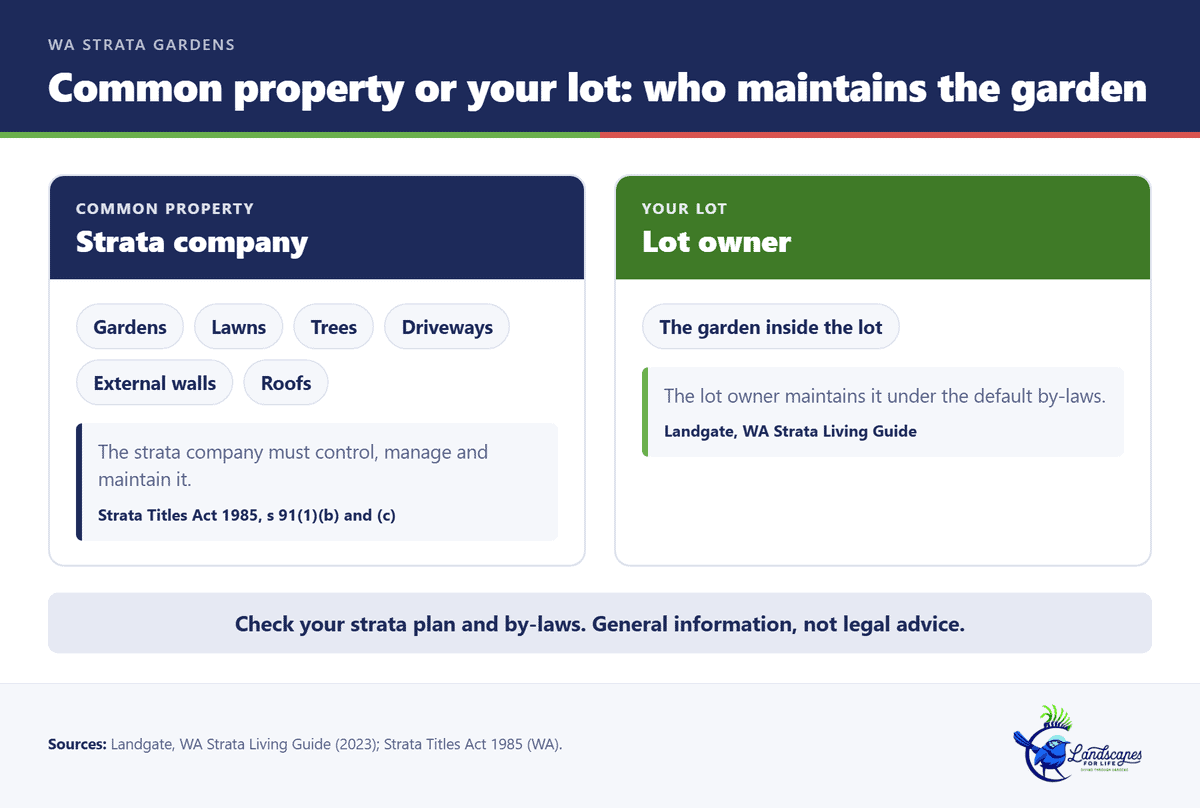
A garden inside a lot is the owner’s job. Landgate says that under the default governance by-laws, the lot owner must maintain and repair the lot and keep it in good condition. Commentary from a WA strata manager goes further: a strata company does not have the authority to spend strata funds on private property. That is commentary, not legal advice, so check your own by-laws.
Trees, hazards and the duty of care
Gardens and trees on common property carry a safety duty as well as a maintenance one. A 2026 WA strata commentary says a strata company must take reasonable steps to manage known hazards on common property, and that the common law duty of care and the Occupiers’ Liability Act 1985 (WA) may also apply.
The same commentary says that “reasonable steps” does not always mean removing a tree. Local Shire restrictions, including Tree Preservation Zones, may limit pruning or removal without approval, and those restrictions do not remove the strata company’s responsibility to manage a known hazard. Get written advice on tree work before you commit to it.
The commentary’s example is falling nuts. Once a hazard like that is known and predictable, the author says the strata company “should treat this as a foreseeable hazard”, which means a plan for it, not a wait-and-see. Ask your contractor to flag hazards in writing during each visit, so the strata council has a record of what it knew and when.
Who pays: the administrative fund
Routine garden care is paid from the administrative fund. Landgate describes that fund as covering the day-to-day expenses of running a scheme, including “ongoing maintenance (such as garden care)”. Its list of administrative fund costs includes gardening, small maintenance jobs and utility bills for common property.
Larger works come from the reserve fund. Landgate describes it as the fund for major work likely to be required in the future. Strata companies with 10 lots or more, or a replacement value of $5 million or more, must have a reserve fund and prepare a 10-year plan.
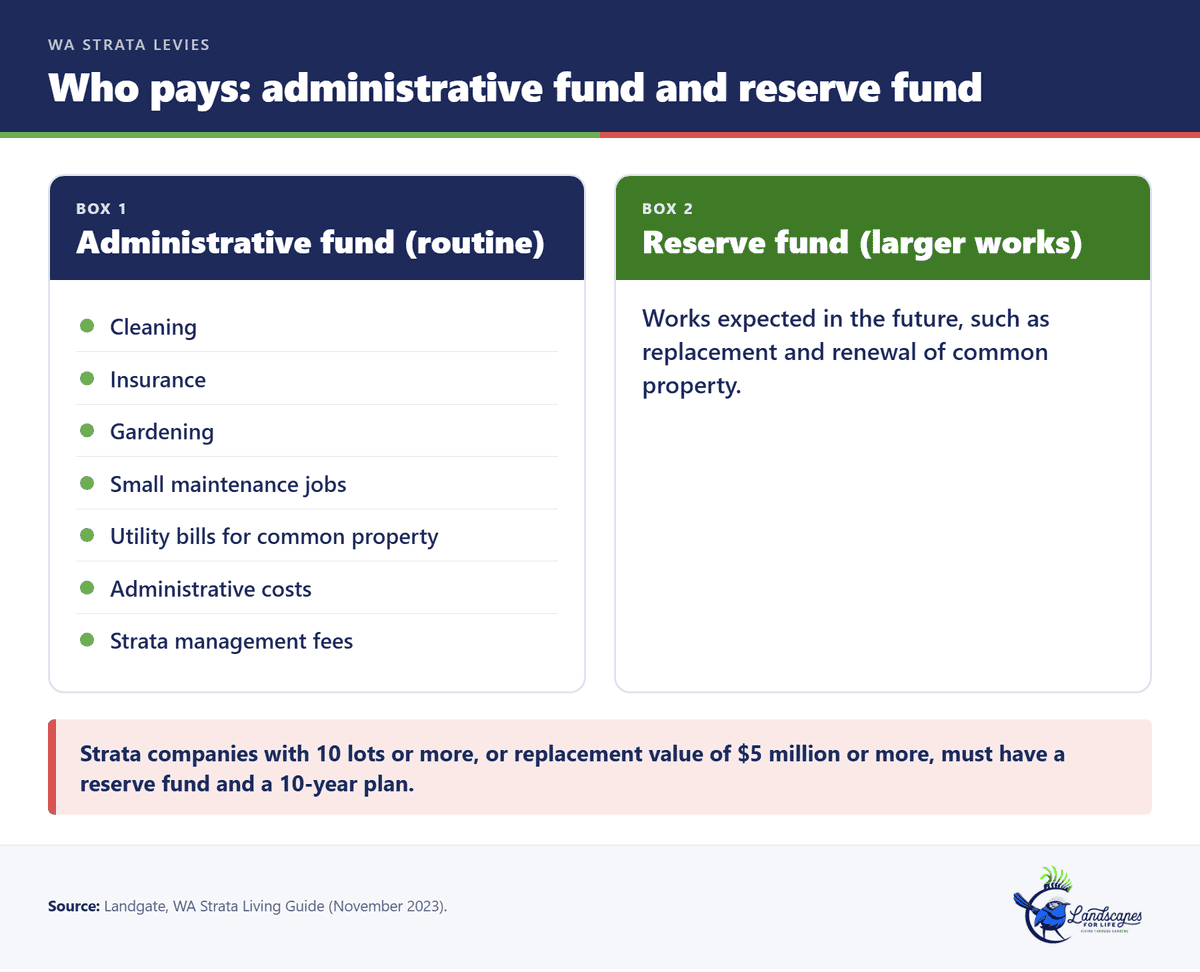
Owners pay their share of both funds through contributions, which Landgate also calls levies. The Landgate guide describes the budget as showing the scheme’s existing financial position, so ask the strata manager to show where the garden line sits in it. A contract that is clear about its scope is the best protection for that budget.
What a strata garden contract usually covers
The contract scope is the part owners most often argue about, so write it down. A commercial garden contractor’s guide lists the core tasks as lawn care, pruning, planting, mulching, irrigation, pest control, seasonal clean-ups and hardscape maintenance. The hazard commentary above adds clearing shed material during peak seasons, arborist reports for risky trees, warning signage where a hazard is known, and records of what was done.
Frequency is the other gap. The commercial guide we read gives no fixed visit schedule. It says pruning should be done “regularly” and recommends seasonal clean-ups. That is why the visit frequency should appear in writing for each season, not as a phrase like “as needed”.
Check the common property rules too. The Landgate guide’s default conduct by-law says an owner or occupier must not, without the strata company’s approval, damage any lawn, garden, tree, shrub, plant or flower on common property, or use common property as a private garden. Owners who want to plant or change a shared garden should ask first.
What it costs
We have not found a published WA price for a strata garden maintenance contract. Any dollar figure for a strata scheme needs a current quote for your scheme’s size and scope.
The closest published figures are marketplace listings for individual gardeners. Airtasker lists Perth general gardening at $110 to $250, with a median of $160, and garden maintenance at $120 to $275, with a median of $200. The page does not say whether these are one-off or recurring jobs, and they are not strata contract prices, so do not use them as a budget.
The price moves with the scope: how often the garden is visited, how much common property there is, and whether mowing, edging, green waste removal, irrigation checks and tree work are included. A cheap quote for a smaller scope is not a cheaper garden.
How to get quotes that compare
Ask every contractor to price the same written scope. Ask the strata manager for the current maintenance contract and the garden line in the administrative budget, so you know what the scheme already pays. Confirm who approves the contract under your scheme’s by-laws before you ask for quotes.
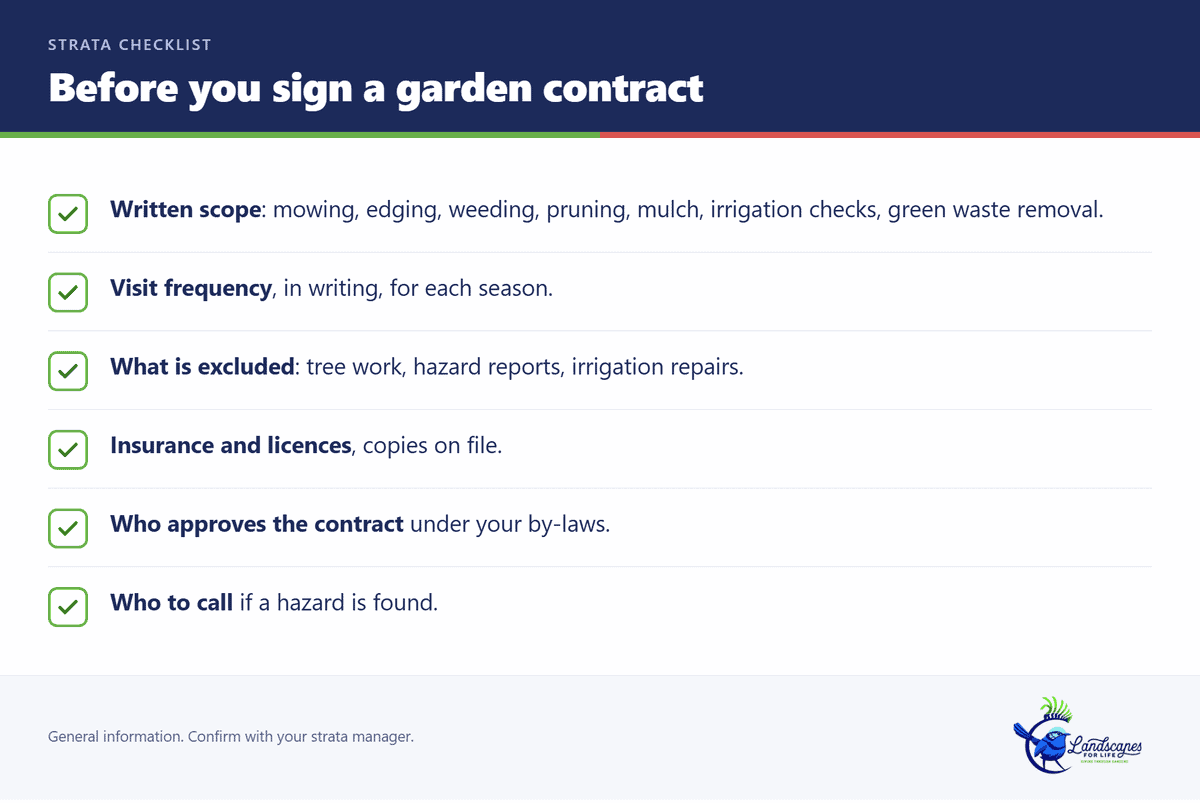
Get at least three quotes on the same scope, and check each contractor’s insurance and licences. Ask who you call when a hazard appears between visits.
Frequently asked questions
Do you do strata and body corporate maintenance?
Yes. We offer garden maintenance for commercial and strata properties, and our commercial work includes the grounds at Royal Perth Yacht Club and Mazenod College. Call us to talk about your scheme.
Who pays for strata garden maintenance?
Routine garden care comes from the administrative fund, funded by owners’ levies. Major works come from the reserve fund. Landgate’s WA Strata Living Guide sets out both.
Who is responsible for a garden on common property?
The strata company. Under section 91 of the Strata Titles Act 1985, it must control, manage, maintain and repair the common property, including gardens, for the benefit of all owners.
Who is responsible for a garden inside a lot?
The lot owner, under the default governance by-laws. A WA strata manager’s commentary says the strata company cannot spend strata funds on private property. Check your scheme’s by-laws before you assume anything.
Can an owner change or damage a garden on common property?
Not without the strata company’s approval. The default conduct by-law says an owner must not damage a lawn, garden, tree, shrub, plant or flower on common property without that approval.
For a garden contract built around your scheme’s scope, our commercial garden maintenance Perth service is where to start. Get a free quote and tell us about the common property you need looked after.
This is general information, not legal advice. Check your scheme’s strata plan, by-laws and the current text of the Strata Titles Act before you act on it.