
Commercial landscaping in Perth is a different job from a home garden. The grounds are the first thing a visitor, parent or resident sees, and they have to look right every week of the year while staying safe, compliant and inside a budget.
This guide is for the people who sign that work off: facility managers, strata council members, school business managers and property managers. We are Landscapes For Life, a family-owned landscaping and garden maintenance company working across Perth since 2009. We look after the grounds at the Royal Perth Yacht Club and have worked on the gardens at Mazenod College in Lesmurdie. Where we could not verify a fact, we say so.
In this guide
- The short answer
- Commercial landscaping in Perth: what a maintenance contract covers
- Commercial garden maintenance in Perth: a year of seasonal scheduling
- Strata garden maintenance: who is responsible in WA?
- WHS and compliance: what to ask a commercial landscaper for
- Schools and aged care
- Tendering, quotes and KPIs
- What does commercial garden maintenance cost in Perth?
- The shift to waterwise and native plantings
- Choosing a commercial landscaper
- Frequently asked questions
The short answer
- Commercial landscaping: the work splits into construction and ongoing maintenance, and most managers spend their time on the maintenance contract.
- Scope: a maintenance contract puts the tasks, the visit frequency and the price in writing. One WA council tender proposed monthly services for most areas, with more frequent visits to high-profile areas.
- Strata: under WA strata law, the strata company (all owners together) must keep the common property, including gardens, in good and serviceable condition.
- Compliance: ask for insurance certificates (including workers compensation), WHS documents, chemical licences and, on school sites, Working with Children Check details.
- Water: the sprinkler switch-off from 1 June to 31 August also applies to licensed groundwater users such as councils, schools and businesses.
Commercial landscaping in Perth: what a maintenance contract covers
Commercial landscaping covers two kinds of work. One is construction. Our construction work covers design, soil rejuvenation, reticulation, turf, plant selection, retaining walls and paving (Landscapes For Life).
The other is maintenance, which keeps all of that looking and working year after year. A maintenance contract is where most facility and strata managers spend their time, so that is the focus here.
Some providers call a single contract that covers mowing, beds, irrigation and reporting comprehensive landscape management. The idea is one accountable provider rather than three separate trades.
What a tender asks for
Tender packs show what clients actually ask for. The Town of Claremont’s 2022 garden and streetscape tender, for example, included weed control on every service by hand, mechanical or chemical means, mulching, hedge clipping, rose pruning and seasonal planting (Town of Claremont).
It proposed monthly services for most areas, with high-profile areas visited more often, and expected the contractor to be working in the Town at least three days a week. The term was two years, with a possible one-year extension.
A typical scope list for a commercial site includes:
- Lawn mowing and turf care
- Weeding and weed control
- Pruning, hedging and shaping
- Mulching and garden bed care
- Fertilising
- Seasonal planting and plant replacement
- Irrigation checks and repairs
- Green waste removal
Write the scope down first
Before you ask for quotes, list what you want in plain terms. A good scope names:
- The zones on the site, such as entry, courtyards, car park edges and perimeter
- The standard for each zone, for example mow height or bed finish
- Visit days and hours, and any times work must avoid
- Who handles irrigation, green waste and plant replacement
- How the contractor will report what was done
That list is what lets you compare three quotes on the same footing. If you want to see how our service is set up, our commercial garden maintenance Perth page covers it, and for new builds see commercial landscaping Perth.
Commercial garden maintenance in Perth: a year of seasonal scheduling
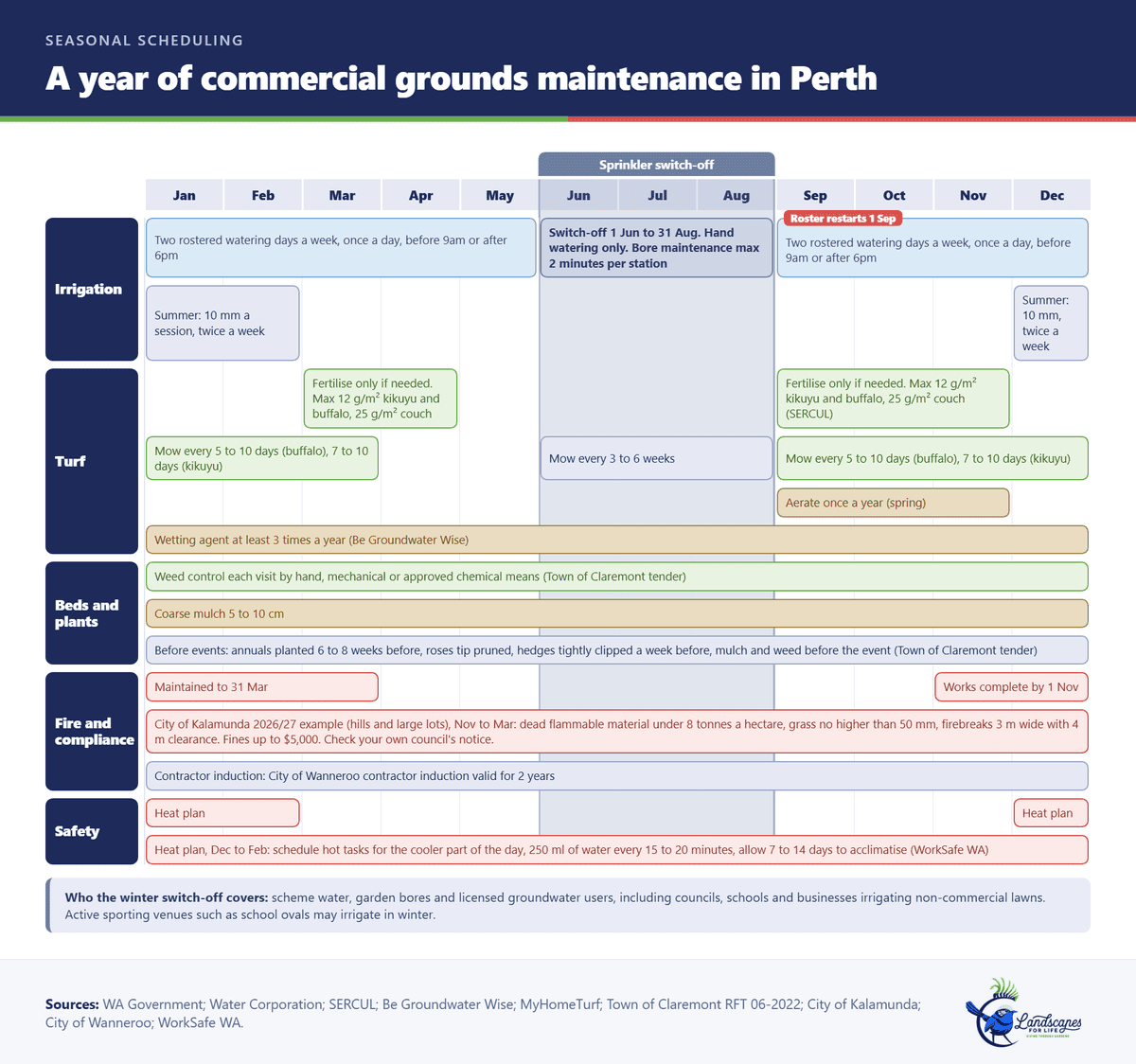
Perth’s climate and rules set the rhythm of the year. A good contractor schedules around them rather than treating every month the same.
Water: the roster and the switch-off
From 1 September to 31 May, scheme water and bore users follow a two-day roster, once a day, before 9am or after 6pm. From 1 June to 31 August the sprinkler switch-off applies.
It covers scheme water users, garden bores and licensed groundwater users, including local governments, schools, golf courses, government departments, universities and businesses irrigating non-commercial turf, lawns or gardens. Active sporting venues such as school and council ovals may irrigate in winter. Hand watering is allowed, and a breach can cost $100 (WA Government).
Turf, feeding and mowing
Fertilise only if the lawn needs it, in spring or early autumn (September to November and March to April). SERCUL’s limit is 12 g/m² per application for kikuyu and buffalo and 25 g/m² for couch (SERCUL).
Mowing runs about every 5 to 10 days in warm months for buffalo, and every 7 to 10 days for kikuyu. In cooler months it stretches to every 3 to 6 weeks (MyHomeTurf). Be Groundwater Wise adds a spring aeration once a year and a soil wetting agent at least three times a year.
Beds, events and the fire season
Beds need weed control and mulch. Be Groundwater Wise recommends a 5 to 10 cm layer of coarse mulch.
Events change the calendar. In the Claremont tender, annuals were planted six to eight weeks before major events, roses tip pruned, hedges tightly clipped a week before and mulch laid on weed-free beds beforehand.
Fire rules matter on larger or bush-edge sites. The City of Kalamunda’s 2026/27 notice requires works complete by 1 November and maintained to 31 March.
Dead flammable material must stay under 8 tonnes per hectare and grass no higher than 50 mm, with firebreaks 3 metres wide and 4 metres clear overhead. Non-compliance can mean a penalty of up to $5,000 (City of Kalamunda). Every council has its own notice, so check yours.
Heat and people
Perth summers are a safety issue as well as a plant issue. WorkSafe WA says to schedule hot tasks for the cooler part of the day, and that workers should drink 250 ml of water every 15 to 20 minutes in hot conditions (WorkSafe WA).
Strata garden maintenance: who is responsible in WA?
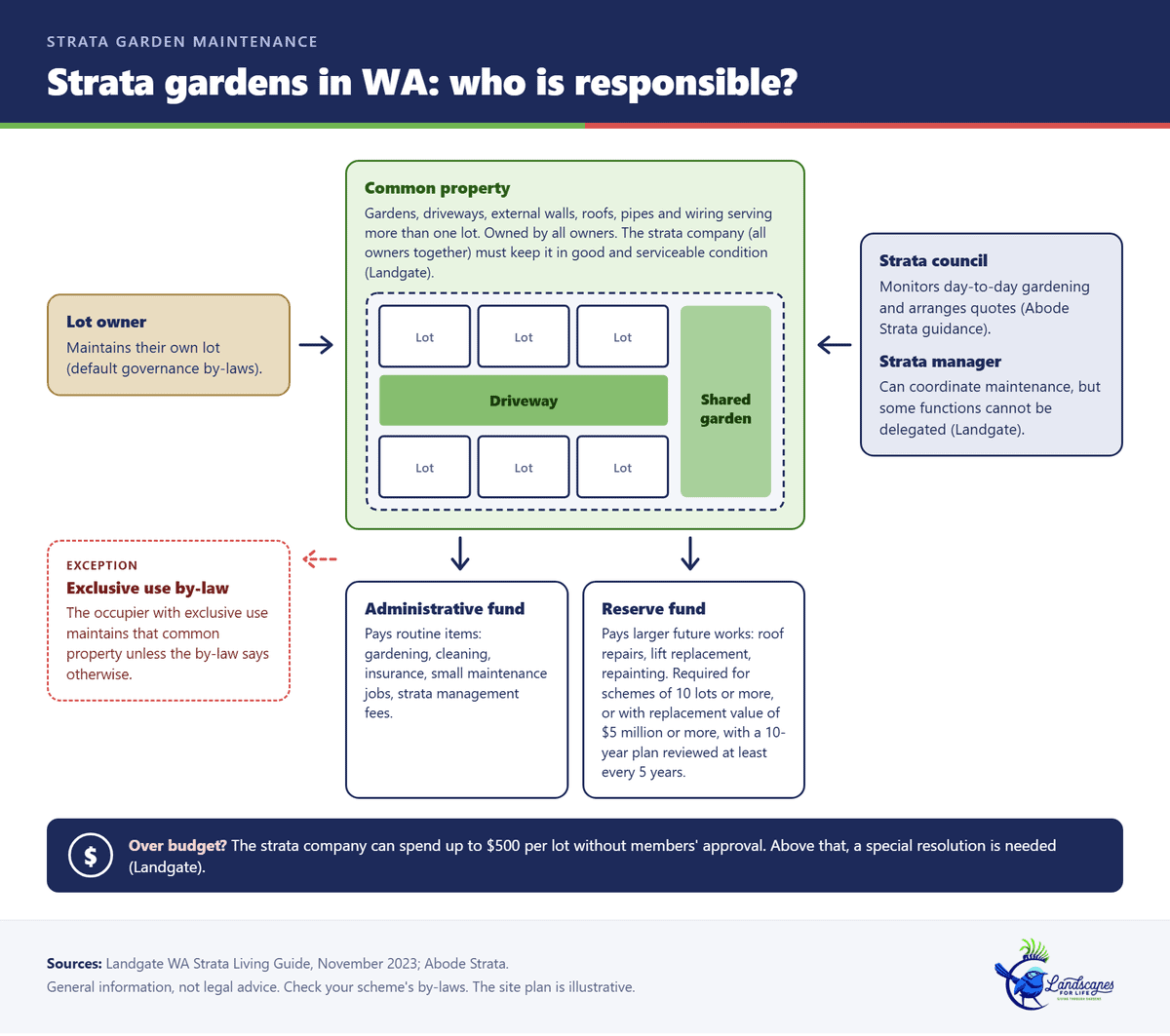
The answer is in the WA Strata Titles Act 1985. Landgate’s WA Strata Living Guide explains it in plain English. This is general information, not legal advice, so check your own by-laws.
Common property belongs to everyone
In a strata scheme, the strata company is made up of all the lot owners, and it is responsible for managing the common property. Common property can include gardens, driveways, external walls and roofs (Landgate).
The strata company must keep common property in good and serviceable condition, including repairs, renewals and replacement. In a survey-strata scheme, the garden areas that are common property are shown on the survey-strata plan.
The exception: exclusive use by-laws
If a scheme has an exclusive use by-law, the occupier with exclusive use of part of the common property is responsible for maintaining it, unless the by-law says otherwise. A lot owner can check by reading the scheme’s by-laws. Inside the lot, the default governance by-laws make the lot owner responsible for maintaining it.
Who pays
Gardening is a routine expense, paid from the administrative fund along with cleaning, insurance and small maintenance jobs. Bigger future works come from the reserve fund. Schemes with 10 or more lots, or a replacement value of $5 million or more, must have a reserve fund and a 10-year plan, reviewed at least every five years.
Small schemes of two to five lots can adopt exemptions from some management functions by registering a governance by-law, so check which rules apply to yours.
Budgets are approved at the AGM. If extra spending is needed beyond the budget, a strata company may spend up to $500 per lot without members’ approval. Above that, it needs a special resolution.
Who decides
The strata council usually oversees day-to-day gardening and arranges quotes, and a strata manager can coordinate maintenance. Landgate notes some powers cannot be delegated to a strata manager. One WA strata consultancy advises a written scope, so quotes compare like with like, checking insurance and strata experience, and keeping minutes of the decision (Abode Strata).
On safety, WorkSafe WA lists residential strata bodies corporate with no employees as not being PCBUs for their common areas. The landscaping contractor you hire still carries its own duties (WorkSafe WA).
For what a strata garden service includes, see our strata garden maintenance in Perth guide.
WHS and compliance: what to ask a commercial landscaper for
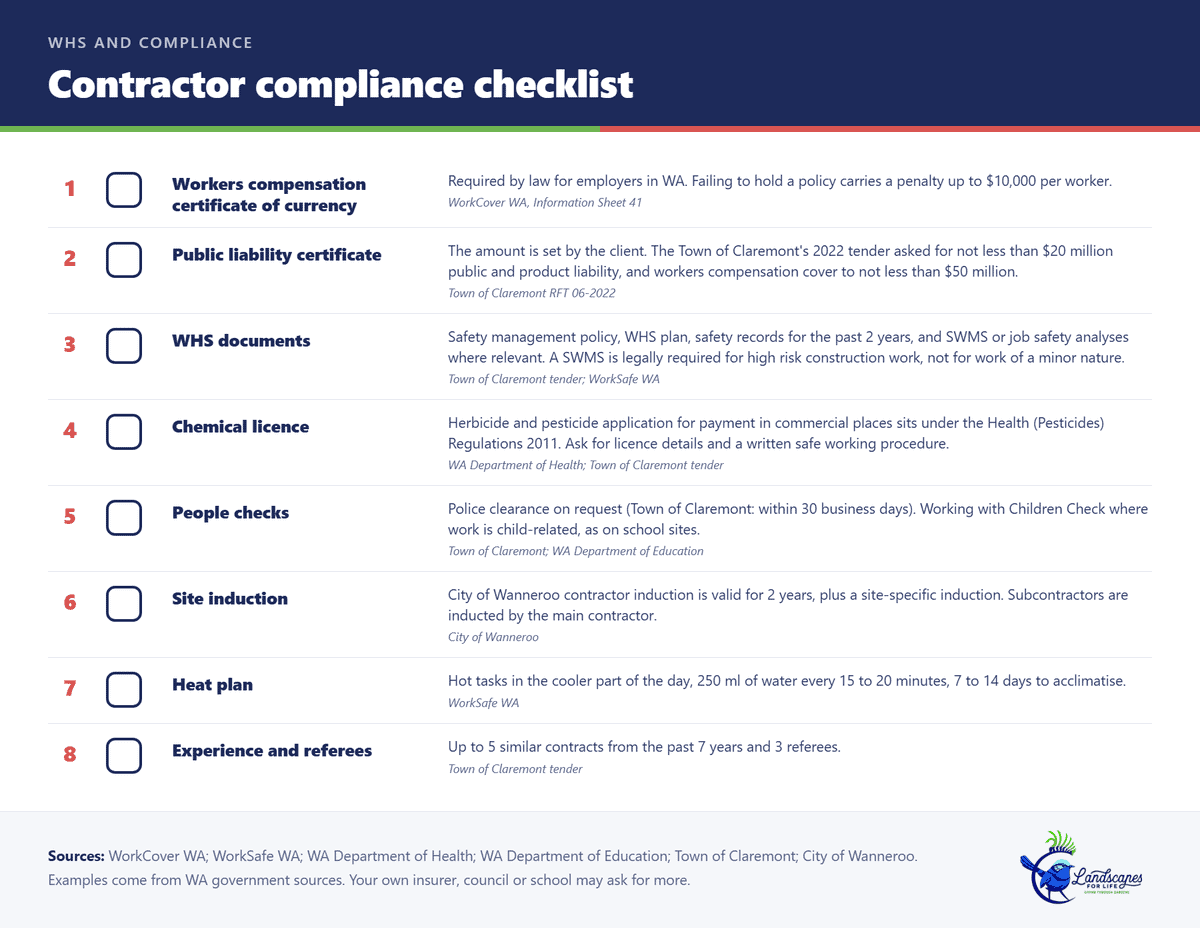
Compliance is where cheap quotes often hide gaps. Here is what to ask for before anyone starts work, with the WA source for each item.
Insurance
Employers in WA must hold workers compensation insurance. The Workers Compensation and Injury Management Act 2023 sets a penalty of up to $10,000 per worker for failing to hold a policy (WorkCover WA).
The amount of liability insurance is set by the client. The Town of Claremont’s 2022 tender asked for liability insurance of not less than $20 million, and workers compensation cover to not less than $50 million.
Work health and safety
Under the Work Health and Safety Act 2020, a person conducting a business or undertaking (PCBU) must ensure the health and safety of its workers so far as is reasonably practicable. A PCBU can be a sole trader, a company or a council (WorkSafe WA).
A SWMS is required for high risk construction work, but not for work of a minor nature (WorkSafe WA). Routine mowing and hedging may not need one by law, yet many clients ask for safe work procedures anyway. The Claremont tender asked for a safety management policy, a WHS plan, risk assessments, SWMS or job safety analyses, and two years of safety records.
Many councils also run their own contractor inductions. The City of Wanneroo’s online induction is mandatory for contractors, valid for two years, with a site-specific induction on top. Subcontractors must be inducted by the main contractor (City of Wanneroo).
Chemicals
Herbicides are pesticides under the Health (Pesticides) Regulations 2011. The Department of Health issues licences to people trained to apply pesticides in public and commercial places for payment, and technicians must work for a registered pest management business (WA Department of Health). Whether a given task needs a licence is for the Department to confirm, at pesticidesafety@health.wa.gov.au.
The Claremont tender went further. It preferred chemical-free weed control, required a written safe working procedure and licensed personnel, wanted signage until sprayed areas were dry, and did not allow glyphosate in public unfenced areas in the Town.
People checks
Police clearances can be requested. In the Claremont contract, a contractor had 30 business days to supply an Australia-wide clearance for any of its personnel on request.
On Department of Education sites, site managers must only contract with external providers they are satisfied are complying with the Working with Children (Screening) Act 2004, and must record Working with Children Check details (WA Department of Education).
What we provide
We carry comprehensive insurance cover, and our team has police clearances. If your contract needs particular documents, tell us when you ask for a quote.
Schools and aged care
Grounds at schools and aged care homes carry extra expectations. People are on site, often vulnerable, and the grounds are part of daily life.
For schools, the main issue is child safety and timing. Work around students needs the right checks, and noisy or chemical work is best planned for out of hours. At Mazenod College in Lesmurdie, Eric wrote: “We are extremely proud of our gardens and how they have developed over the last 2 or so years” (Landscapes For Life testimonials).
For aged care, the grounds are part of the care environment.
We do not list aged care work here. If you manage an aged care site, call us and tell us what you need.
We did not find a WA Department of Education grounds-maintenance standard for contractors, beyond the Working with Children procedures above.
Tendering, quotes and KPIs
The best quotes compare like with like. Start with a written scope and a site walk.
The Claremont tender is a useful model of what formal buyers weigh. Price counted for 30 percent. Specified personnel, capacity to do the work and demonstrated experience were 20 percent each, and work health and safety 10 percent. Contractors had to list up to five similar contracts from the past seven years and provide referees for at least three.
Its contract price was firm for the term, with no annual CPI increase. It also inspected works 14 days after a herbicide application to issue any reworks.
Contract terms worth reading
Read the commercial terms as closely as the price. The Claremont pack said the Town did not guarantee the quantity of work, could use other contractors, and held the contractor responsible for replacing any turf, plants, shrubs or trees damaged by a wrongly applied herbicide.
None of that is unusual in commercial landscaping, but it tells you what a bidder is signing. Ask what happens if you add a garden bed, remove a lawn or need an urgent clean-up between scheduled visits.
KPIs
For KPIs, we suggest agreeing these in writing with whichever contractor you choose:
- A fixed task list per visit and a visit schedule
- A response time for hazards, such as a fallen branch or a broken sprinkler
- A window for fixing defects, and what happens if it is missed
- A reporting format, such as a visit log with dates and tasks
- Review meetings, and a way to vary the scope
We could not find a published WA benchmark for these numbers, so set them with your contractor. For a strata scheme, keep minutes of the decision and invoices itemised so a future council can see what was done.
What does commercial garden maintenance cost in Perth?
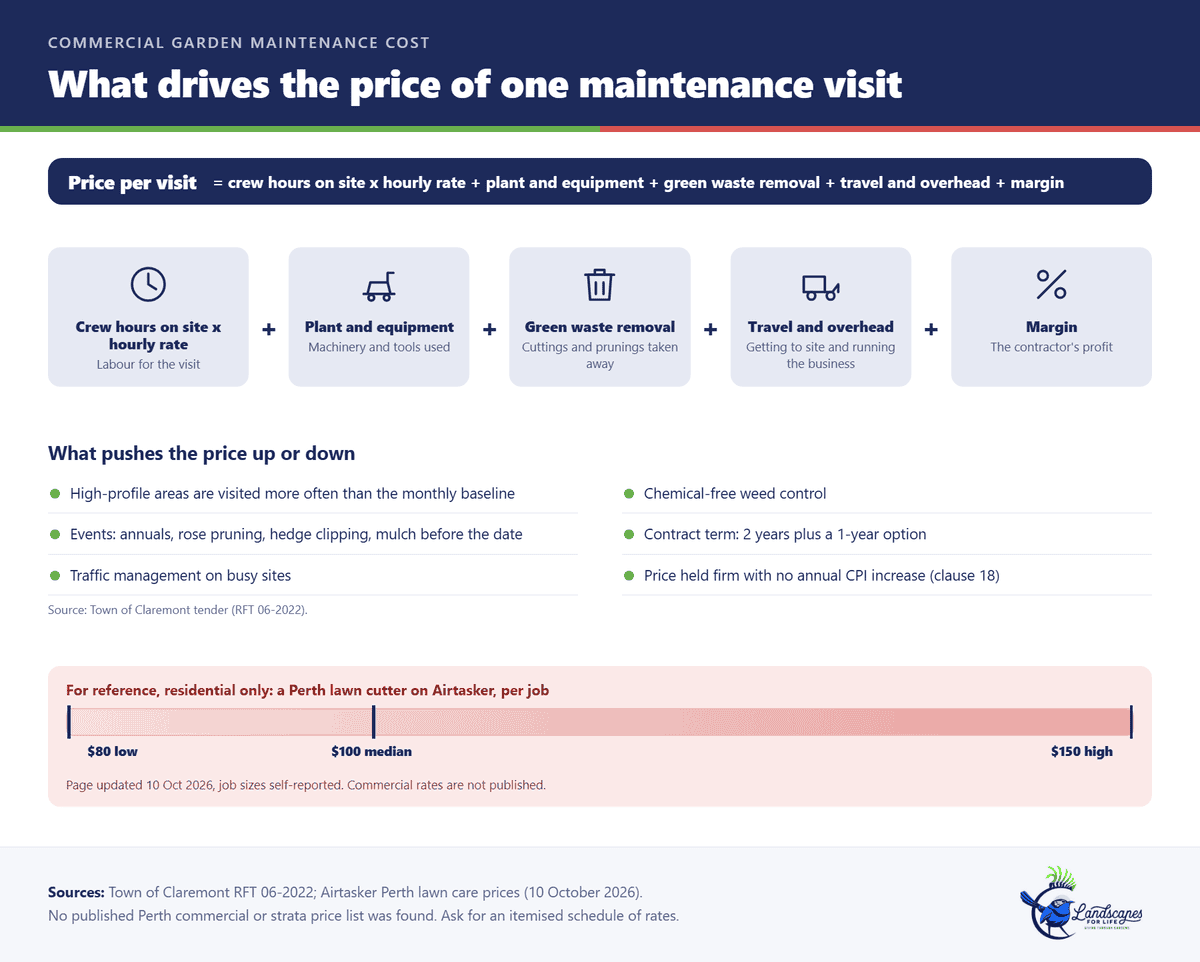
We could not find a published Perth price list for commercial or strata garden maintenance, and prices vary with the site. We would rather say so than invent a number.
The only Perth figures we found are residential. Airtasker lists Perth lawn cutters from $80 to $150 a job, with a median of $100, though job sizes are self-reported (Airtasker). A commercial site is a different job.
What moves the price:
- Site size and complexity: more area, more beds, more hedges.
- Frequency: monthly, fortnightly or weekly, and extra visits for high-profile areas.
- Events: planting, pruning and clipping to a date.
- Access: traffic management on busy sites.
- Method: chemical-free weed control takes more labour.
- Contract terms: length, and whether the price is held for the term.
Ask each bidder for an itemised schedule of rates, so you can see what a visit, an extra visit and a variation each cost.
The shift to waterwise and native plantings
Commercial sites are moving to waterwise gardens and native plantings, driven by water rules, running costs and public expectations. We cover the trend in detail in our guide to commercial landscaping trends in Perth.
The tools are well known. Be Groundwater Wise recommends waterwise Western Australian native and drought-tolerant plants, grouped into hydrozones so irrigation can match each group’s needs, with a 5 to 10 cm layer of coarse mulch (Be Groundwater Wise).
Water Corporation runs a Waterwise Landscaper and Garden Designer Program, with training that includes commercial landscape water use and endorsement renewed every two years through Landscape Industries Association WA (Water Corporation).
The state government’s Waterwise Greening Scheme co-funds native plant giveaways, waterwise verges and street trees for waterwise-endorsed councils. Last year it funded 82 waterwise verges and 115,000 waterwise plants (WA Government).
The practical point for managers: a waterwise redesign changes the maintenance contract. Native beds need different pruning, mulching and irrigation checks than lawn and annuals, so write that into the scope.
Choosing a commercial landscaper
Good commercial landscaping is a long relationship, not a one-off job, so choose a contractor you can call on a Monday morning. Use a short checklist. Do they hold the right insurance and documents? Have they worked on sites like yours? Will they walk the site and itemise the quote? Can they give references?
Our own record is the proof we point to. Clem Rogers, Harbourmaster at the Royal Perth Yacht Club Fremantle Annexe, wrote: “The team are efficient, reliable and show a real interest in the care and upkeep of our grounds” (Landscapes For Life testimonials).
If you want help with a strata complex, a school, or an office or hospitality site, talk to us.
Frequently asked questions
Do you do strata and body corporate maintenance?
Yes. We maintain gardens for commercial and strata properties across the Perth metro area. Call us for a free quote on your common property gardens.
Do you do schools and aged care?
We have worked on school grounds, including Mazenod College in Lesmurdie. We do not list aged care work here, so call us and tell us about your site. On WA public school sites, contractors doing child-related work need a valid Working with Children Check.
Do you provide compliance reports and insurance certificates?
Any contractor should be able to show insurance cover. We carry comprehensive insurance cover, and our team has police clearances. Ask any contractor for workers compensation certificates, WHS documents and chemical licences, and tell us what your contract needs when you ask for a quote.
Who is responsible for garden maintenance in a WA strata scheme?
The strata company, made up of all the lot owners, must keep common property including gardens in good and serviceable condition. The exception is where an exclusive use by-law gives an occupier responsibility for part of the common property.
How often should a commercial garden be maintained?
It depends on the site. One WA council tender proposed monthly visits for most areas and more frequent visits for high-profile areas. Turf mowing runs about every 5 to 10 days in warm months and every 3 to 6 weeks in cool months.
Ready to talk about your site?
If you manage a strata scheme, school or commercial site and want a clear price, get a free quote and tell us about your site.
Sources
- Landgate: WA Strata Living Guide (November 2023)
- WorkSafe WA: Safe work method statements for high risk construction work
- WorkSafe WA: Person conducting a business or undertaking (PCBU)
- WorkSafe WA: Working safely in hot conditions
- WorkCover WA: Information Sheet 41, Insurance requirements for employers
- WA Department of Health: Pest industry licensing and registration
- WA Department of Health: Guide to obtaining a pest management technicians licence
- WA Department of Education: Working with Children Checks in Department of Education sites procedures
- City of Wanneroo: WHS induction for contractors
- Town of Claremont: RFT 06-2022 tender pack
- City of Kalamunda: Fire hazard reduction notice 2026/2027
- WA Government: Winter sprinkler switch-off
- Water Corporation: Become endorsed as waterwise
- WA Government: Waterwise Greening Scheme opens (2025)
- Be Groundwater Wise: Waterwise gardens, lawns and verges
- SERCUL: Fertilise Wise
- MyHomeTurf: Lawn care for Perth’s climate
- Abode Strata: Selecting the right contractors
- Airtasker: Perth lawn care prices
- Landscapes For Life: Testimonials and Commercial landscaping