Commercial landscaping in Perth is shifting in three ways: waterwise design, native planting and tighter expectations on safety and approvals. The WA Government’s Urban Greening Strategy sets the direction. The Water Corporation’s rebates are built for homes, not commercial sites. Councils are setting their own limits on synthetic turf. This guide sets out what has changed, what it means for a commercial site, and where the official sources stop.
What is changing commercial landscaping in Perth in 2026
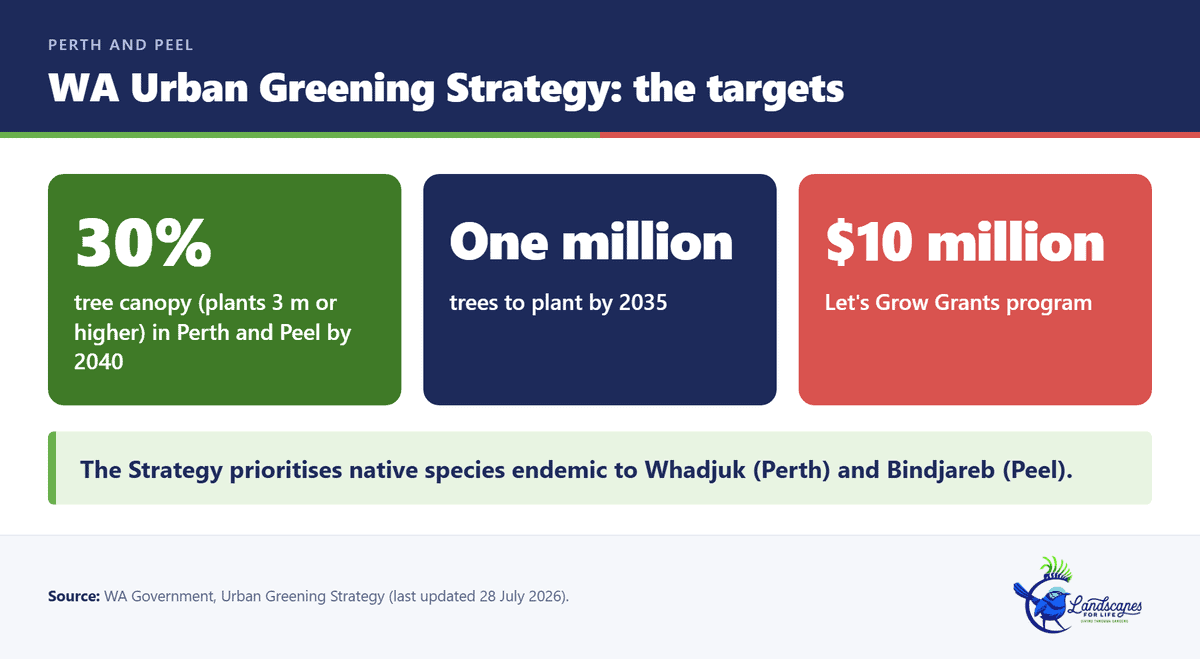
The most important recent document is the WA Government’s Urban Greening Strategy for Perth and Peel. The page we checked was last updated on 28 July 2026. Its targets are a 30 per cent tree canopy (plants three metres or higher) across Perth and Peel by 2040, and one million trees planted by 2035. It also funds a $10 million Let’s Grow Grants program and a $6.9 million Treebate incentive.
The strategy says that “retaining and planting vegetation on private property is vital to achieving the Strategy’s target”. It also commits the State to working with industry to make greening standard practice in infill and greenfield development. For commercial owners and developers, that is the signal to plan for planting, not just paving.
Greening is also being written into the planning rules. The strategy points to minimum tree-planting and garden-area requirements in the Residential Design Codes for new homes and major renovations. Those rules apply to housing, not to commercial sites, so check the local planning scheme for a commercial project.
Waterwise: the rebates a commercial site may not get
The Water Corporation’s 2025-26 Waterwise Irrigation Rebate is worth knowing about, but it is not a commercial rebate. It offers up to $200 for eligible irrigation services, and it is available to residential property owners in Perth and Peel who are Water Corporation customers. The 2025-26 window ran from 1 September 2025 to 31 May 2026, or until 1,825 rebates were claimed, so it has closed.
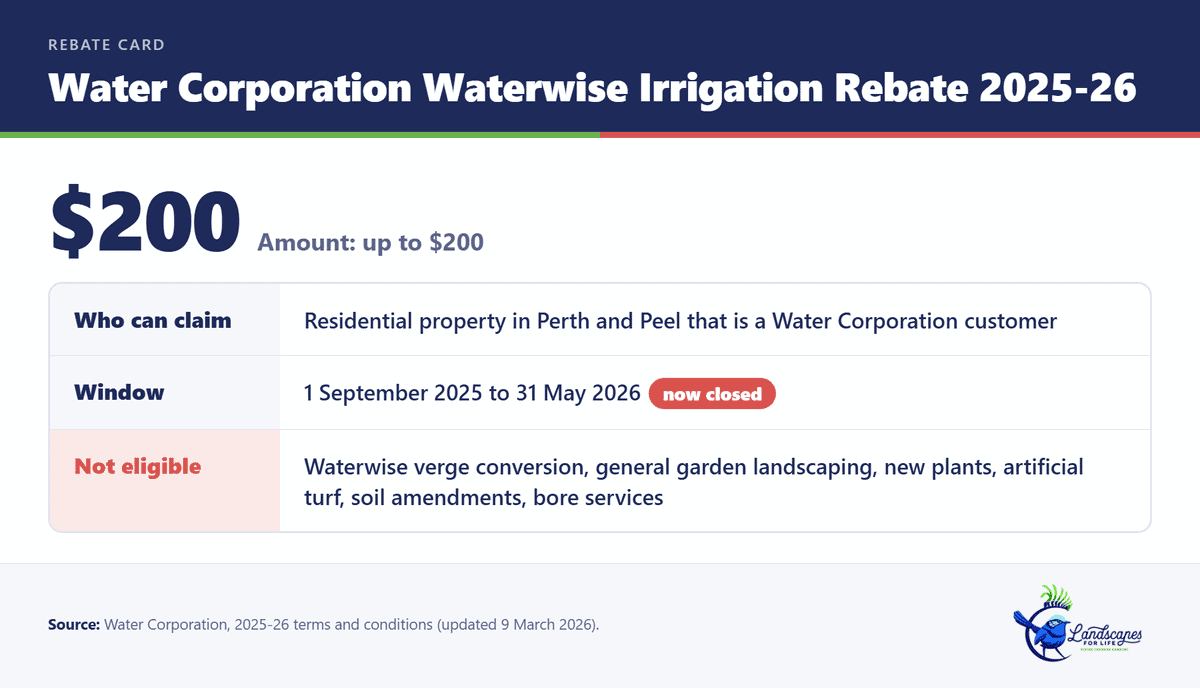
The Corporation says the focus is “saving water not general maintenance”. The eligible services are fixing pipe leaks, replacing faulty solenoid valves and checking the automatic controller, so a rebate-led plan will not pay for a garden redesign. The rebate excludes waterwise verge conversions, general garden landscaping, new plants and artificial turf, soil amendments and bore services. We did not find the 2026-27 terms in the pages we checked, so check the Water Corporation’s Waterwise pages before you tell a client a rebate is available.
Councils run their own verge programs. The Town of Bassendean’s 2026 round has closed, and the Town says funding is first come, first served. Its page does not say whether strata companies or businesses can apply, so ask the council directly before you count on one. The Town expects the next round to open in April 2027, which is its estimate.
Landscape design trends in Perth: native and waterwise planting
The Water Corporation’s garden design guidance for Perth and the South West gives two points that shape commercial plant choices. The first is that native plants “are naturally adapted to the local climate, soil and environmental conditions, meaning they require less water and maintenance than non-native plants”. The second is soil preparation: before planting, incorporate bentonite clay and organic compost or soil-wetting agents into the top layer of soil.
The Urban Greening Strategy takes the same line. It “prioritises native species, particularly those endemic to Whadjuk (Perth) and Bindjareb (Peel)”, while accepting some non-native species where they provide shade or resilience. It also says the strategy “promotes urban greening without compromising water resources”.
We did not find a credible 2026 Perth trends report, so this list is built from the government and utility guidance above, not from a designer survey. Treat it as direction, and check each design against the site’s sun, drainage and water supply.
Synthetic turf: check the council before you specify it
Synthetic turf on commercial frontages and verges needs a council check. In September 2024 the City of Cockburn said its Street Verge Improvement Policy requires approval where more than 25 per cent of a verge is paved, including with synthetic turf or hard surfaces. Hard surfaces must also show heat mitigation through tree planting or landscaping, and permeability.
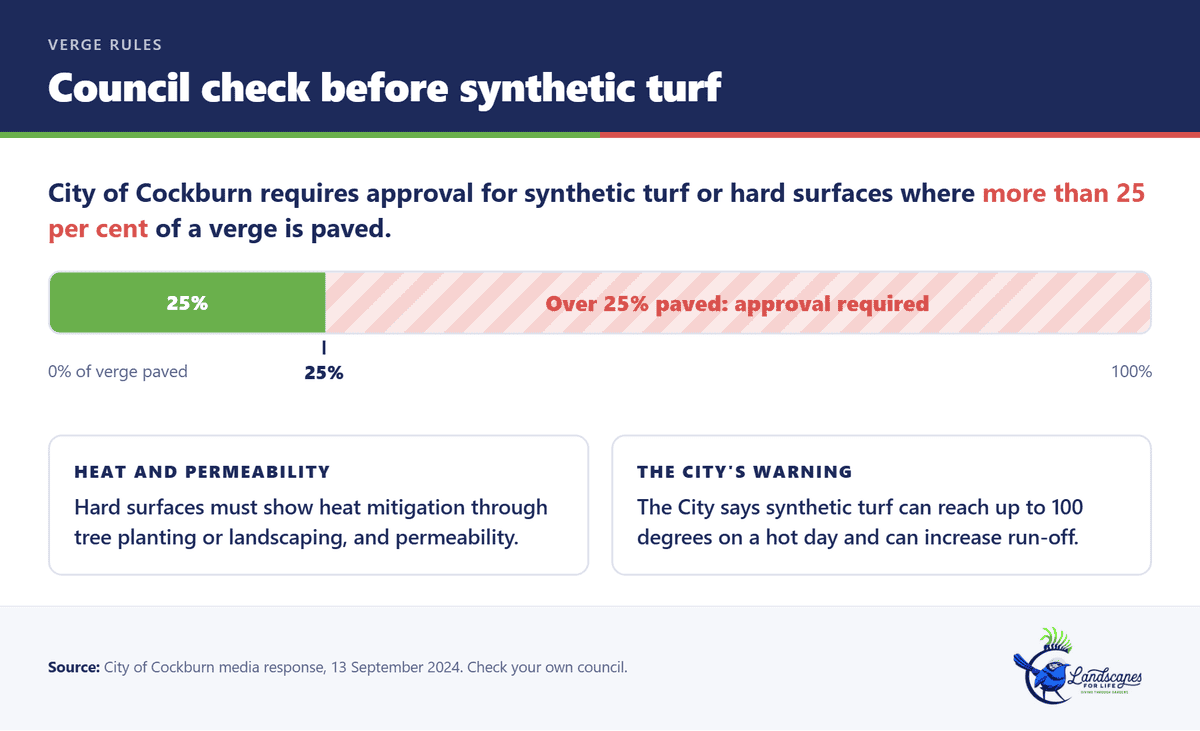
The City is firm on covering the whole verge. It says synthetic turf “contributes to the urban heat island effect as it can reach up to 100 degrees on a hot day”, and that covering a whole verge “can increase water wastage and run-off”. That is one council’s position from 2024, so check the rules for the property’s own council before you quote. The Water Corporation rebate also excludes artificial turf.
Compliance: what WorkSafe WA expects from a landscaping crew
WorkSafe WA’s code of practice, “Managing risks of plant in the workplace”, applies to all types of work and all workplaces covered by the Work Health and Safety Regulations, wherever plant is operated, used or stored. The code defines plant broadly, including machinery, power tools and mobile plant. A ride-on mower or a brush cutter falls under it, so a landscaping business has to manage the risks those machines create.
The code is written for a person conducting a business or undertaking, which is the business doing the work, not only the property owner. That means a landscaping crew cannot treat its machines as the client’s problem. It has to identify the hazards from its own equipment and control them as part of its own work.
The code page we checked was published on 14 July 2022 and updated on 26 November 2024. It does not list mowers or roll-over risks by name, so read the full PDF and its hazard checklist before you write a safety procedure for a crew.
This guide does not cover WA requirements for chemical use, subcontractor insurance or the site documents a commercial client may ask for. Check those with WorkSafe WA.
Frequently asked questions
Do you do strata and body corporate maintenance?
Yes. We offer garden maintenance for commercial and strata properties. For the maintenance side of commercial work, see our commercial and strata landscape maintenance in Perth guide.
Do you provide compliance reports and insurance certificates?
We carry comprehensive insurance cover, and our team has police clearances. If a commercial contract needs particular documents, tell us when you call for a quote.
Can a commercial property claim the Water Corporation irrigation rebate?
No. The 2025-26 Waterwise Irrigation Rebate is for residential property in Perth and Peel, and its window closed on 31 May 2026. Check the Water Corporation’s Waterwise pages for any later program.
Is synthetic turf allowed on a commercial verge in Perth?
It depends on the council. The City of Cockburn requires approval where more than 25 per cent of a verge is paved, including with synthetic turf. Check the verge policy for the council that covers the property.
Do you do schools and aged care?
Our commercial work includes the grounds at Mazenod College. For any other kind of site, including aged care, call us and tell us about it.
If you are planning a commercial site, get a free quote and tell us about the frontage, the drainage and the water supply. For projects, see our commercial landscaping in Perth page.