
Waterwise landscaping in Perth starts with the rules, so we open with the sprinkler ban Perth households live under every winter: no sprinklers from 1 June to 31 August, and a two-day roster for the other nine months. From there we cover why the rules keep tightening, how much water a garden really needs, and how to build a garden on Perth sand that copes. Every rule and number below comes from a source we opened on 15 October 2026, and we name the source in each section.
In this guide
- The sprinkler ban and water restrictions in Perth, 2026-27
- Why Perth’s water rules keep tightening
- How much water does a Perth garden really need?
- Hydrozoning: put thirsty plants where you can reach them
- Soil first: wetting agents, clay and mulch on Perth sand
- Waterwise plants for Perth: natives, exotics and drought tolerant picks
- Irrigation: smart controllers, drip and getting the roster right
- Low maintenance landscaping in Perth
- Waterwise verges and council programs
- Frequently asked questions
The sprinkler ban and water restrictions in Perth, 2026-27
Water restrictions in Perth are not an emergency measure. They are permanent, and they apply to scheme water users and to garden bore owners alike. The WA Government describes the winter switch-off as “a permanent water-efficiency measure”, and its page was last updated on 21 May 2026.
The rules fit on one card, and we have set them out here so you can check yourself against them.
Your watering days: it is your street number, not your suburb
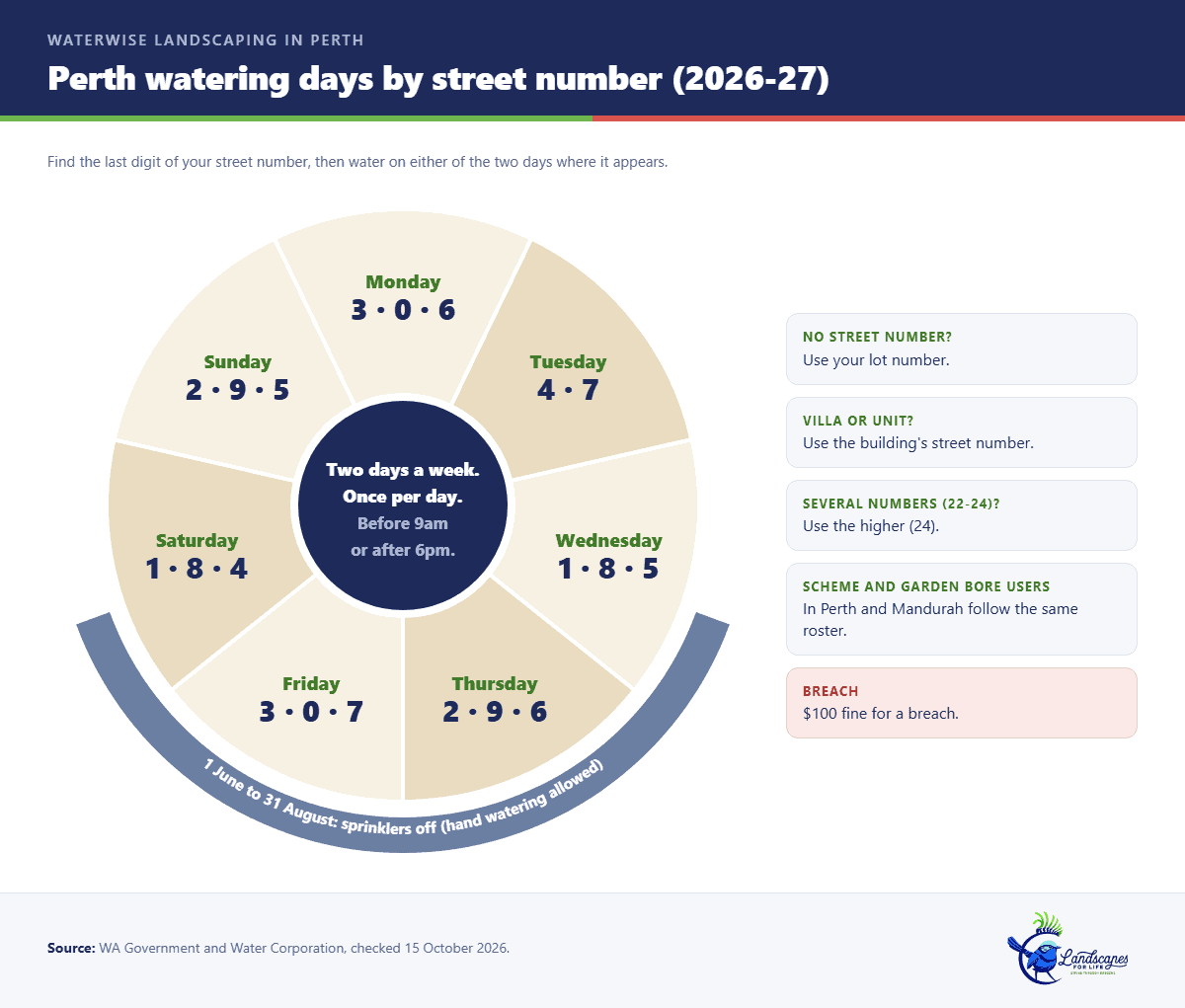
Your watering days come from the last digit of your street number. In Perth and Mandurah, scheme water users and garden bore users follow the same table, with two days a week and one watering per day.
| Last digit of street number | Watering days |
|---|---|
| 1 or 8 | Wednesday and Saturday |
| 2 or 9 | Thursday and Sunday |
| 3 or 0 | Friday and Monday |
| 4 | Saturday and Tuesday |
| 5 | Sunday and Wednesday |
| 6 | Monday and Thursday |
| 7 | Tuesday and Friday |
A few cases trip people up:
- No street number? Use your lot number. If you later get a street number, switch to it.
- Villa or apartment? Use the street number of the building, not your unit number. Unit 1 at 22 Water Street uses 22.
- Several numbers on one property? Use the higher one. For 22-24 Water Street, that is 24.
The Water Corporation also has a lookup that takes your street number and postcode. Our separate guide to Perth watering days and sprinkler rules goes through the daily window and the table in more detail.
The daily window
On a rostered day you can water once, and only before 9am or after 6pm. That applies to sprinklers on scheme water and on a garden bore. A faulty controller is not an excuse: the Water Corporation says a malfunctioning controller does not excuse watering outside your days, and it recommends replacing backup batteries regularly, especially after a blackout.
Hand watering is treated differently. The Water Corporation allows it any day, preferably before 9am, with a watering can or a handheld hose with a nozzle (one outlet). The hose cannot be attached to a sprinkler or left running unattended.
The sprinkler ban: 1 June to 31 August
Every year from 1 June to 31 August, sprinklers are switched off across Perth and Mandurah, and in the South West including Albany. That is the sprinkler ban Perth searches are really about. Per the WA Government page, it covers:
- scheme water users;
- domestic garden bores; and
- licensed groundwater users such as councils, schools and businesses watering non-commercial turf and gardens.
Active sporting grounds are allowed to irrigate in winter. Hand watering is permitted throughout. You do need to turn the system off yourself: the WA Government page says a breach can be fined even if you are away. Bore owners may service their system, but only to the minimum extent necessary, which the department treats as no more than two minutes per station, ideally on a roster day and before 9am or after 6pm.
The next ban starts on 1 June 2027, and the roster restarts on 1 September.
Fines and inspections
The fine for using sprinklers between 9am and 6pm, during the switch-off, or outside your rostered days is $100. The Water Corporation says inspectors work seven days a week and investigate complaints. Garden bore breaches are passed to the Department of Water and Environmental Regulation, which may issue the infringement.
For bore owners there is a bit of history worth knowing. The State Government’s groundwater page says the bore roster was cut from three days to two from 1 September 2022, with enforcement from 1 September 2023, and expects the change to save up to 30 GL of groundwater a year.
Watering a new lawn or garden
New plantings are the one situation where you can water more, but you need to apply. The Water Corporation exemption for scheme water customers runs:
- 1 October to 31 March: up to 42 days from planting, at a recommended 10 mm of water a day.
- 1 April to 30 September: up to 35 days from planting, at a recommended 7.5 mm of water a day.
Apply on the day you plant to get the full period. You pay for the extra water, and random inspections can follow: the Water Corporation warns of a $500 fine for non-compliance, and the property owner, not the installer, is responsible for a breach. The scheme water exemption does not apply to properties with a licensed bore. The WA Government’s garden bore page says garden bore owners also need a temporary exemption to water new lawns and gardens outside the roster or during the switch-off, and gives 1800 508 885 to ask.
Why Perth’s water rules keep tightening
The roster exists because the water behind it has changed. The numbers are worth knowing, because they explain why waterwise landscaping is now the default rather than a nice extra.
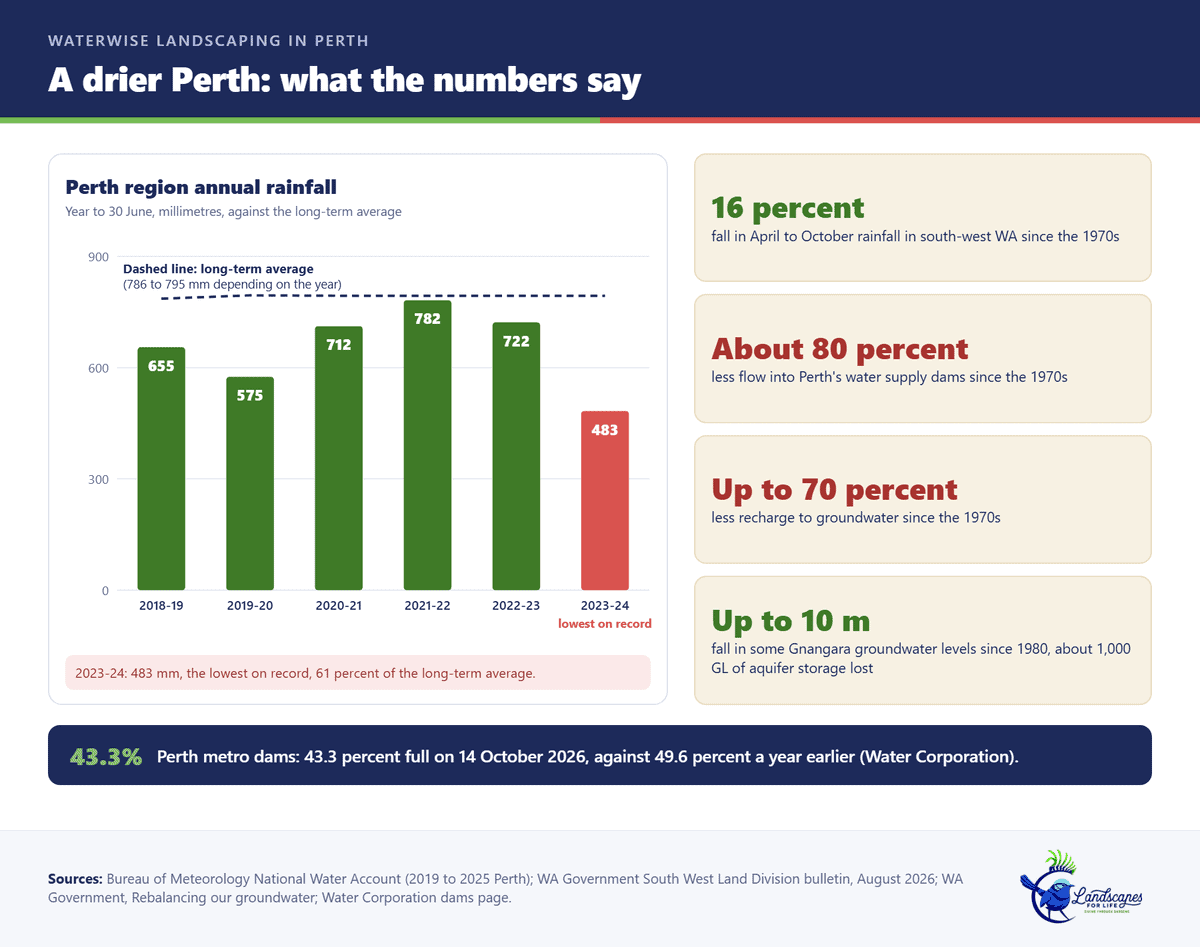
Rainfall. The WA Government’s August 2026 bulletin for the south-west says that since the 1970s there has been a 16 per cent decline in April to October rainfall, about 80 per cent less flow into Perth’s water supply dams, and up to 70 per cent less recharge to groundwater. The Be Groundwater Wise factsheet puts the fall in Perth’s average rainfall at about 15 per cent since the mid-1970s. Other pages quote slightly different percentages, usually because they use different periods, so treat the figure as roughly 15 to 20 per cent.
Recent years. The Bureau of Meteorology’s National Water Account for Perth recorded 483 mm of rain in 2023-24, the lowest on record, at 61 per cent of the long-term average of 794 mm. Its 2025 account says rainfall in 2024-25 was below average for the seventh consecutive year. This year is dry too: the August 2026 bulletin says January to August rainfall was mostly below to well below average in the south-west corner, and the Hotham and Swan rivers recorded their lowest streamflow on record so far this year.
Dams. The Water Corporation’s dams page shows Perth metro dams at 43.3 per cent (272.89 GL) on 14 October 2026, against 49.6 per cent a year earlier. The Corporation says the dams now work more as storage than as a main source.
Groundwater. Be Groundwater Wise says about 70 per cent of all the water used across Perth and Mandurah comes from groundwater, and more than 100,000 households use garden bores. The State Government says water tables across the Gnangara Mound have dropped by up to 10 metres in some areas since 1980, about 1,000 GL of aquifer storage lost. Garden bores take about 90 GL a year, or 22 per cent of all groundwater abstraction in the area.
The practical message is simple. Less rain and less recharge mean the two-day roster and the winter ban are not going away, and a garden that needs three or four sprinkler days a week is fighting the rules.
How much water does a Perth garden really need?
The Water Corporation’s guideline is 10 mm of water, twice a week in summer, for gardens and lawns in Perth. It adds that more than that gives plants no extra benefit. Ten millimetres over one square metre is 10 litres, so the rostered maximum works out to about 20 litres per square metre per week in the hottest months. (That conversion is our arithmetic from the Water Corporation figure.)
Be Groundwater Wise suggests a simple check: put catch cups on the lawn and see whether your sprinklers actually deliver 10 mm in a run.
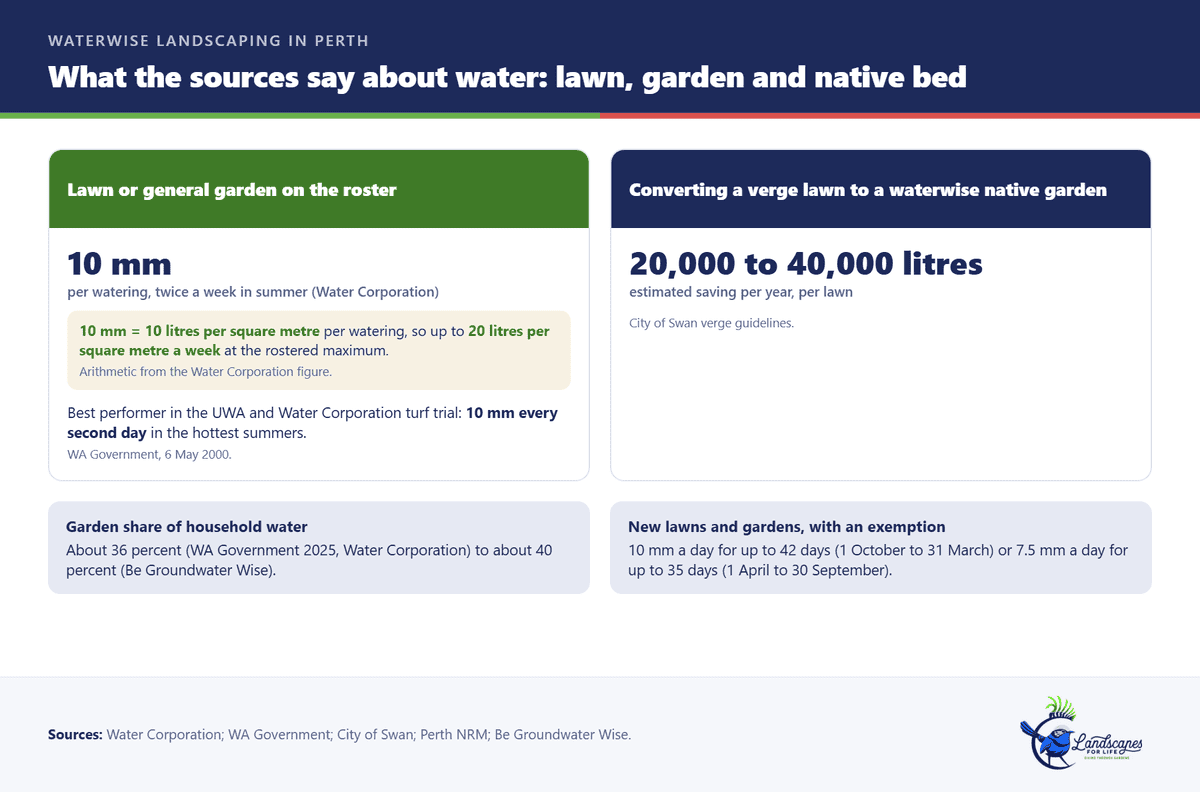
Gardens take a big share of household water. The WA Government’s 2025 release puts garden use at 36 per cent of household water, the Water Corporation’s watering page says the average household uses about 36 per cent of its scheme water in the garden, and Be Groundwater Wise says about 40 per cent. Bore households use more.
What about lawn against native bed? Here is what the sources give us:
- The City of Swan estimates that converting a verge lawn to a waterwise garden saves around 20,000 to 40,000 litres of water a year per lawn.
- In the UWA and Water Corporation turf trial at Shenton Park, announced in 2000, the best-performing turf needed 10 mm every second day in the hottest summers.
- Perth NRM says natives that get through two summers on a watering allocation should have deep roots and be largely self-sufficient.
None of these gives a percentage saving for an established native bed, so we do not quote one. What the sources support is that natives that get through two summers should become largely self-sufficient, which makes the first two summers the ones to get right.
Hydrozoning: put thirsty plants where you can reach them
Hydrozoning means grouping plants by how much water they need, then giving each group its own irrigation station. The Water Corporation puts it plainly: plants with similar water needs grow best together, and hydrozoning lets you set irrigation stations to deliver the right amount of water to the right plants.
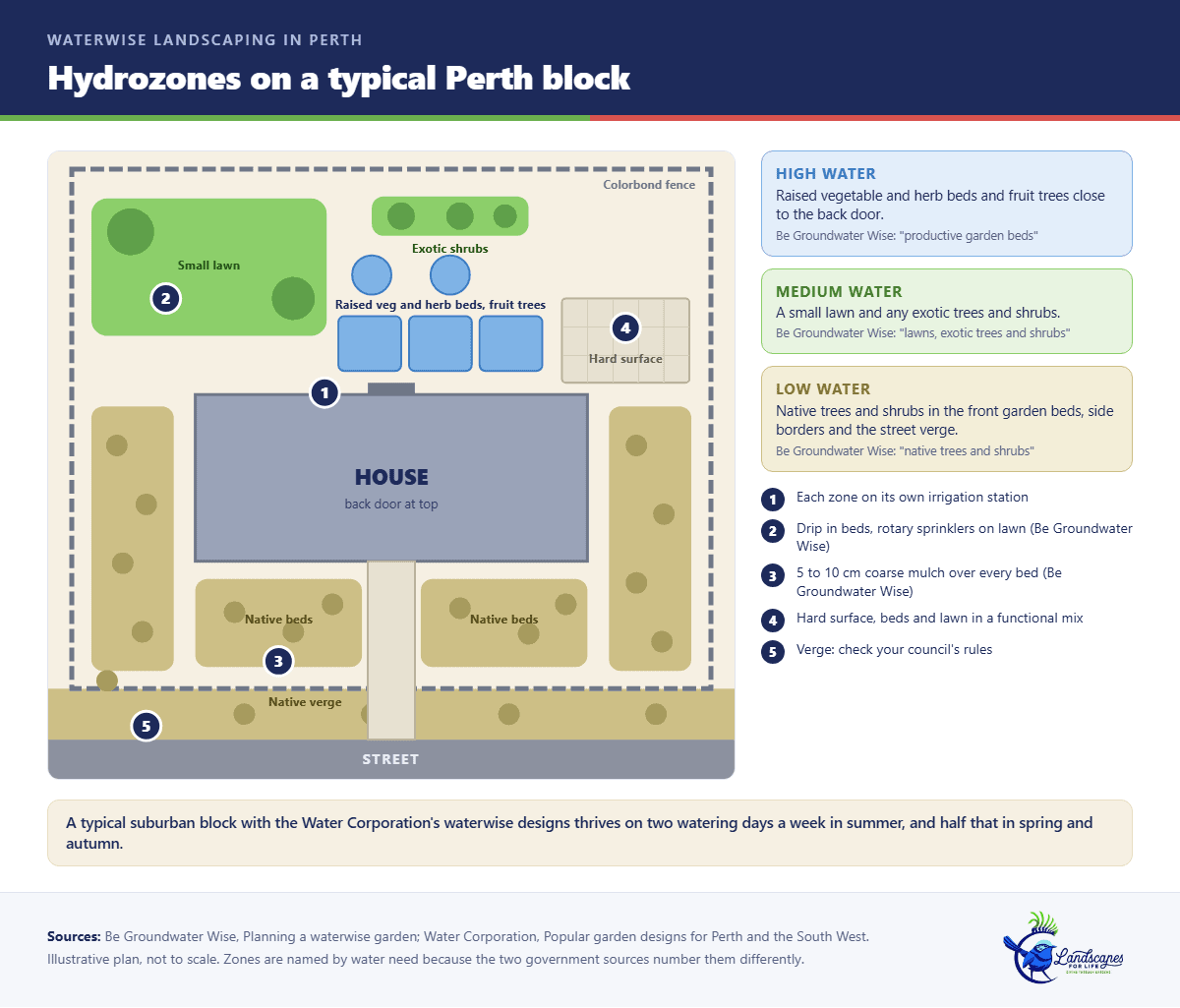
Be Groundwater Wise describes three zones:
- High resource needs: productive garden beds, such as vegetables and herbs.
- Medium resource needs: lawns, and exotic trees and shrubs.
- Low resource needs: native trees and shrubs.
The Water Corporation’s own garden designs use the same three groups but label them in a different order, with vegetables, herbs and fruit trees in “Hydrozone 3”. The numbers do not matter. The idea does. On a typical Perth block it looks like this:
- Raised veggie and herb beds near the back door, where you will actually tend them.
- A smaller, better-placed lawn where the family uses it, not a lawn left over.
- Native and low-water planting in the front garden, side borders and verge.
- Hard surfaces such as paving and paths mixed with the beds, which Be Groundwater Wise calls a “functional mix” of hard surface, garden beds and lawn.
The Water Corporation says a typical suburban block with its waterwise designs thrives on irrigation on two watering days a week in summer, and half that in spring and autumn. That is a useful design target: if your plan needs more than that, change the plan before you change the sprinklers.
Soil first: wetting agents, clay and mulch on Perth sand
Perth sand drains fast and, when dry, repels water. UWA’s Professor Maria Ignatieva notes that soils in Perth are mostly sandy and hydrophobic because the city sits on ancient sand dunes. The Water Corporation calls soil the first and most important step in a waterwise garden.
Water-repellent sand
Water running off the surface of a dry bed instead of soaking in is the classic sign. Three levers help:
- Wetting agents. Be Groundwater Wise suggests applying a soil wetting agent at least three times a year. Eva Ricci of the Turf Growers Association WA, quoted by the Water Corporation, suggests applying a quality wetting agent with a soil moisture retainer at the start of spring, in early December, in late January or early February, and at the end of April. Perth NRM recommends a liquid wetter so water penetrates to the roots.
- Clay and compost. For water-repellent sand, the Water Corporation says to mix clay and organic compost into the top layer when planting. Perth NRM’s advice for natives is lighter: a good handful of bentonite clay and a handful of vegetable-based compost in the planting hole, and avoid manure-based compost, which is too rich for many natives.
- Aeration for lawns. Be Groundwater Wise suggests aerating a lawn annually in spring, so a wetting agent can get to the roots.
One caution on wetting agents. A 2011 Murdoch University study of five commercial wetting agents on Swan Coastal Plain sand found they improved water infiltration somewhat, but the effect was short-lived, and a few days later infiltration was similar to untreated sand. That does not mean wetters are useless. It means they work best as part of a system with organic matter and mulch, and that you reapply when you see water beading on the surface.
Mulch
Be Groundwater Wise recommends a 5 to 10 cm layer of coarse mulch to reduce evaporation. The Water Corporation suggests chunky mulch about 10 cm deep. The City of Swan sets a minimum recommended settled depth of 75 mm for verges, and says to avoid peat moss and to buy from reputable suppliers to reduce the risk of spreading dieback.
Waterwise plants for Perth: natives, exotics and drought tolerant picks
“Drought tolerant plants Australia” is a huge search, but the answer is local. A plant that thrives in Sydney or Adelaide may sulk in Perth’s winter-wet, summer-dry sand. The Water Corporation’s Waterwise plant search is the WA-specific tool.
What the WA sources recommend
Native and WA-endemic plants are the backbone of most waterwise gardens here. Examples that appear in Water Corporation garden designs and Perth NRM and council plant lists:
- Groundcovers: running postman (Kennedia prostrata), ground banksia (Banksia blechnifolia), snake bush (Hemiandra pungens), thick-leaved fanflower (Scaevola crassifolia) and creeping boobialla (Myoporum parvifolium).
- Shrubs: native rosemary (Westringia dampieri), coastal correa (Correa alba), cushion bush (Leucophyta brownii) and dune moses (Acacia lasiocarpa).
- Strappy plants: kangaroo paw (Anigozanthos manglesii), Western Australia’s state floral emblem and listed by the City of Kalamunda as waterwise and drought-hardy, purple flag (Patersonia occidentalis), grey cottonheads (Conostylis candicans) and dianella.
- Trees: Ashby’s banksia (Banksia ashbyi) appears in the Water Corporation’s native and coastal designs.
That is a starting point, not a shopping list. The Water Corporation also lists well-chosen exotic plants as waterwise: its cottage and Mediterranean designs use non-native plants chosen for lower water use. For the full design approach, see our guide to native garden design in Perth.
Native versus exotic: honest trade-offs
Tim Davies, a Waterwise Landscaper quoted by the Water Corporation, says the most successful gardens tend to be planted with hardy or native species suited to our climate. There are two caveats:
- Natives are not zero-water in year one. They need regular watering to establish, and the exemption for new plantings exists for that reason.
- A mixed garden is fine. A small lawn, a veggie patch and native beds can work together if each has its own zone.
Irrigation: smart controllers, drip and getting the roster right
Most of the water wasted in a Perth garden is wasted through irrigation that is set wrong, not through plants.
Match the sprinkler to the bed
Be Groundwater Wise recommends drip-line irrigation in garden beds and rotary or gear-drive rotator sprinklers on lawns, because they distribute water more evenly and avoid waste. Use the catch cup test above to check you are delivering about 10 mm. Check and maintain sprinkler fittings regularly to avoid leaks.
Seasonal settings
Switch the controller off when it is raining, no matter the season, and during winter. Use the seasonal adjustment setting so the system waters less in spring and autumn. The Water Corporation says to reduce watering times in spring and autumn, and to switch irrigation off in winter and in the wet season.
Smart (weather-based) controllers
Weather-based controllers use local weather data to adjust run times. The best Perth evidence we found is a Water Corporation trial of 60 households in 2015-16, which found an average reduction of 15 per cent in total water use in the first year, about 95,000 litres per household. The State Government offered a $200 rebate for these controllers in 2019. Rebates come and go: the Water Corporation’s Waterwise Irrigation Rebate (up to $200 for a leak and solenoid-valve service by a participating irrigator) is currently closed, so check the Waterwise offers page before you plan around one.
The roster still applies to a smart controller. Program your days and times first, then let the weather feature do the fine tuning.
If your system is old, leaking or watering the footpath, see our reticulation installation and repairs in Perth service.
Low maintenance landscaping in Perth
Low maintenance does not mean no maintenance, and it does not mean pouring concrete over the block. It means a garden designed so the work it needs is small and predictable. The Water Corporation’s advice comes down to these points:
- Right plant, right place. Hardy or native plants in the right zone need less pruning, feeding and watering. The Water Corporation says well-designed gardens need less care.
- Group by water needs. Separate zones mean you do not overwater a dry bed to keep the lawn alive.
- A functional mix of surfaces. Beds, a right-sized lawn and paved areas, as Be Groundwater Wise suggests, reduce mowing and watering.
- Mulch every bed and top it up each year.
- Automatic irrigation, set properly, with seasonal adjustment.
We offer landscaping, garden design, plant selection and installation, and soil rejuvenation for Perth’s sandy soil. If you want a design built around your block, see our garden design Perth service.
Waterwise verges and council programs
The strip between the kerb and your boundary is often the thirstiest, ugliest part of a Perth street. Councils set the rules, and several support waterwise verges. Rules differ, so check yours. We looked at three.
City of Swan. Shrubs and groundcovers, grass, organic mulch and irrigation are allowed on the verge without permission. Paving, synthetic turf and compact aggregate need written permission. Concrete, asphalt, loose aggregate and structures such as walls and planter boxes cannot be installed. The City also offers up to half a cubic metre of free mulch from its Bullsbrook recycling centre, subject to availability.
City of Belmont. Belmont allows native, waterwise or edible gardens, with plants kept below 75 cm. It bans synthetic turf, loose materials such as gravel, concrete, and retaining walls and sleepers on verges. Irrigation must follow your watering days and the winter switch-off. In February 2026 the City opened its Verge Garden Program, a free Verge Makeover Starter Kit with native plants, mulch, soil conditioner, fertiliser and a guide, plus a workshop. Spots were limited, so check whether it is open.
City of Kalamunda. Its verge conditions (version 1.0, July 2020, which may have been updated) allow vegetation that is waterwise, local or endemic, or low in fertiliser demand, and limit non-vegetated areas (paving, gravel, sand, synthetic turf) to 50 per cent of the verge. Fencing and walls are not permitted on the verge. Kalamunda’s Plants for Residents program offers free native plant packs, described as waterwise and low maintenance; expressions of interest opened on 13 April 2026. We did not find a cash rebate from any of the three councils.
At state level, the WA Government’s 2025 Waterwise Greening Scheme reports $140,000 awarded to 18 waterwise-endorsed councils in the latest year, 82 waterwise verges, 115,000 waterwise plants, and more than 400,000 plants given away since 2019-20.
Frequently asked questions
When can I use my sprinklers again after the winter ban?
The ban ends on 31 August. From 1 September you can water again on your two rostered days, once per day, before 9am or after 6pm. The next ban starts on 1 June 2027.
What are the Perth watering days for my suburb?
Your watering days are set by the last digit of your street number, not your suburb. A street number ending in 1 or 8 waters on Wednesday and Saturday, 2 or 9 on Thursday and Sunday, 3 or 0 on Friday and Monday, 4 on Saturday and Tuesday, 5 on Sunday and Wednesday, 6 on Monday and Thursday, and 7 on Tuesday and Friday.
How much is the fine for breaking sprinkler rules?
The fine is $100 for using sprinklers between 9am and 6pm, during the 1 June to 31 August switch-off, or outside your rostered days. Bore breaches go to the Department of Water and Environmental Regulation.
Can I water a new lawn or garden during the ban?
Only with an exemption. For scheme water customers, the Water Corporation allows up to 42 days from planting between 1 October and 31 March, or up to 35 days between 1 April and 30 September, and you pay for the extra water. Properties with a licensed bore are not covered by that exemption.
What are the best waterwise plants for Perth gardens?
Plants listed in Water Corporation designs and local council guides include kangaroo paw, running postman, ground banksia, native rosemary, coastal correa, cushion bush, purple flag and dianella. The best choice depends on your soil, sun and street.
Plan a waterwise garden with us
We are a family-owned Perth landscaping and garden maintenance company, working since 2009, with comprehensive insurance cover and police-cleared staff. If you want a garden that works with the roster, tell us about your block and get a free quote.