
A native garden suits Perth because the plants already know our sand. Perth Natural Resource Management, a regional body, says local natives are adapted to sandy soils and need them, rather than simply putting up with them. This post sets out how to prepare a sandy block for natives, which WA species suit a home garden, where to find local stock, and what the sources say about watering a new native garden through its first summers. Where two sources disagree, we show both.
Why natives suit Perth’s sandy soils
Water Corporation describes a native garden as a good fit for the local climate. It flowers year-round, and it attracts birds and wildlife. Its advice on natives is that they are adapted to local conditions, need less water and maintenance, and flower through the year.
If you want the design and build handled for you, see our residential landscaping in Perth page. Water is the reason to choose carefully. Water Corporation’s low-maintenance guidance notes that Perth households use more than half of their total water on gardens. A garden of plants that are already adapted to our rainfall, and that are rated waterwise, keeps that share under control.
Start with the soil for a native bed
Here the sources differ, so we show both.
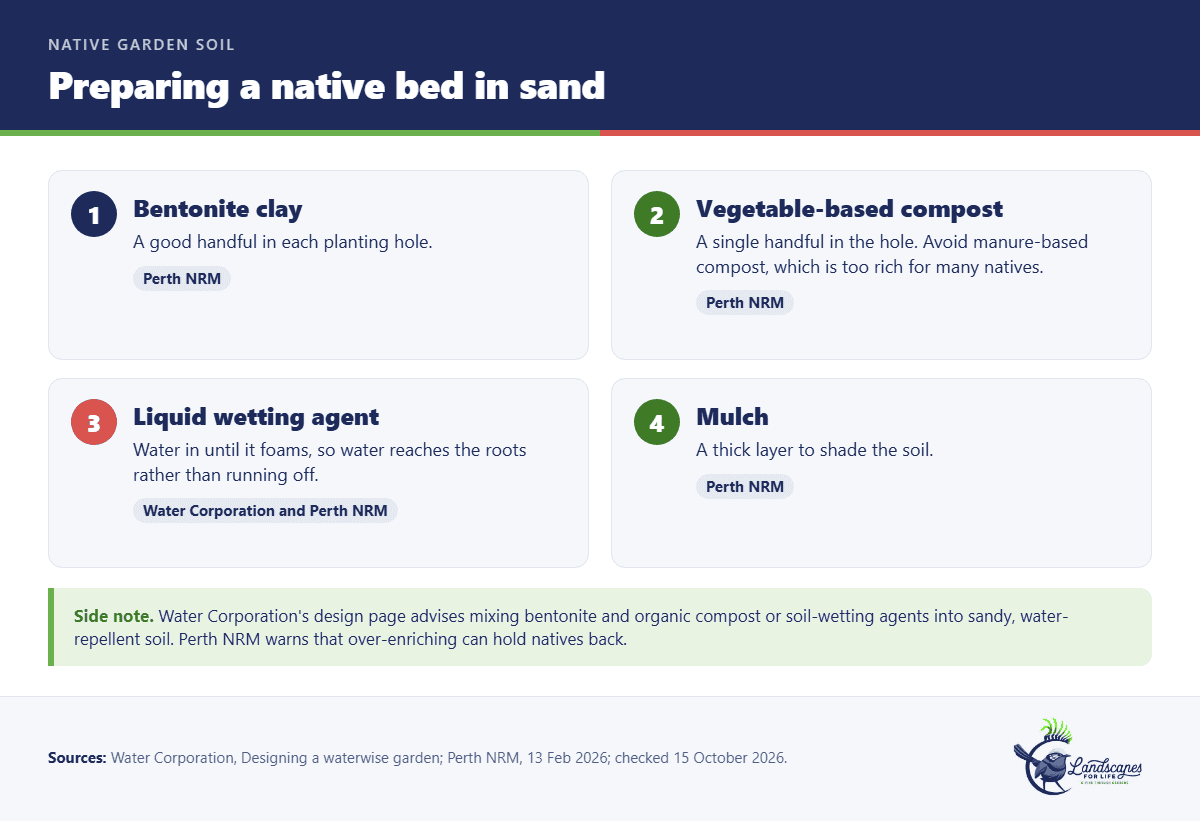
Water Corporation’s design guidance for sandy, water-repellent soil is to mix bentonite clay and organic compost or soil-wetting agents into the top layer, then water in the wetting agents until they foam.
Perth NRM takes a lighter hand. It warns that over-enriching can hold natives back, and it recommends a good handful of bentonite clay and a single handful of vegetable-based compost in each planting hole. Manure-based compost is often too rich for natives. It also recommends a liquid wetting agent so water reaches the roots, and a thick mulch to shade the soil.
Our reading is that the two fit together: use the small quantities Perth NRM gives, and use wetting agents on the sand. Heavy compost is the step to skip.
Water Corporation’s guidance on establishment is the one to plan around. It says a new garden may qualify for a watering exemption, so the soil stays moist while the plants settle in. Perth NRM says that after the first two summers, a well-established native should have deep roots and can largely look after itself.
Native plants for a Perth home garden
The City of Kalamunda’s Habitat Pack 2025 is a useful council list because each plant carries a water rating and a height. Its ten plants are all rated waterwise and drought-hardy, except Angled lobelia, which has no waterwise rating and needs moist soil in exposed sites. For the wider picture on water use, see our waterwise landscaping Perth guide.
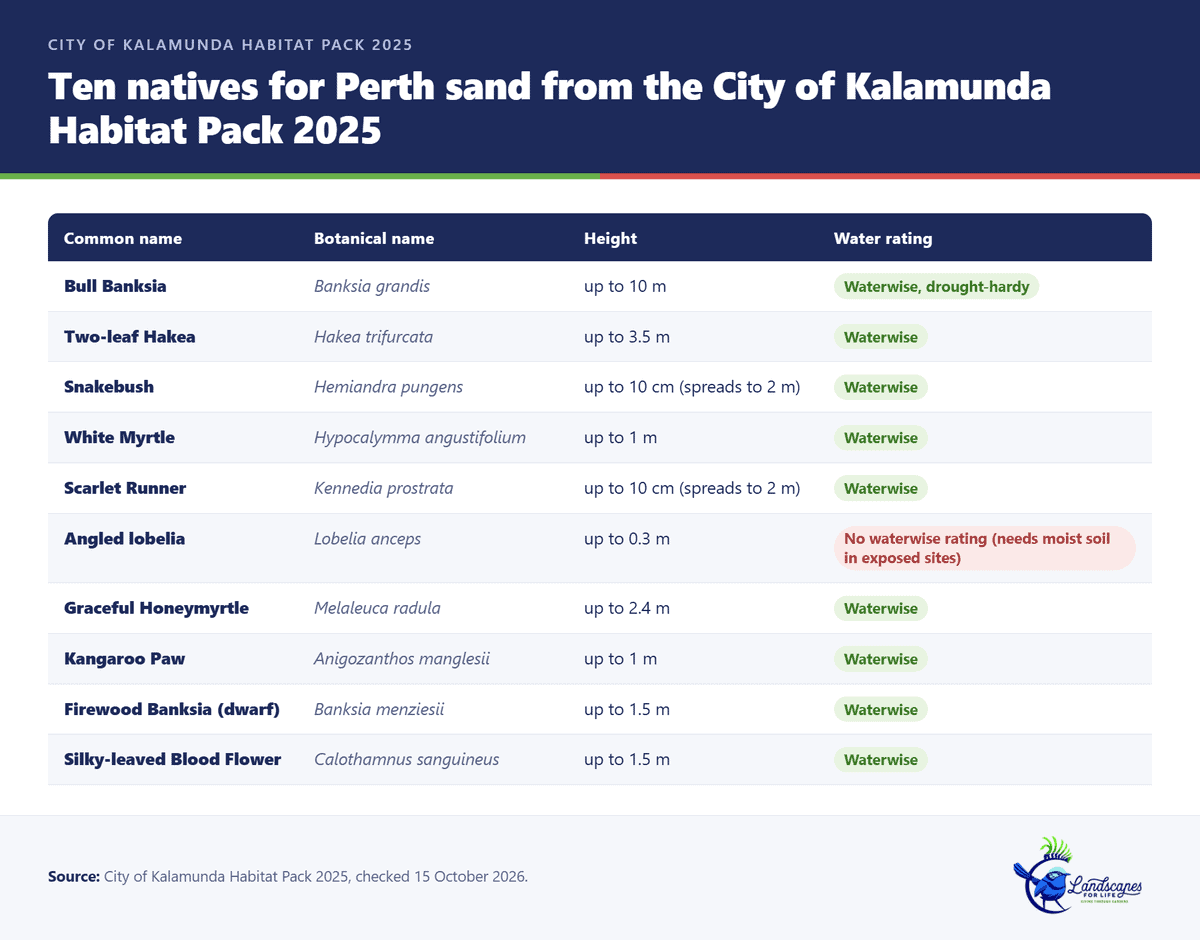
For a home garden, the pack’s heights matter most:
- *Bull Banksia (Banksia grandis)*, up to 10 m. A tree for larger blocks only.
- *Graceful Honeymyrtle (Melaleuca radula)*, up to 2.4 m, a shrub that suits a screen or back border.
- *Silky-leaved Blood Flower (Calothamnus sanguineus)*, up to 1.5 m, with red flowers.
- *Kangaroo Paw (Anigozanthos manglesii) and White Myrtle (Hypocalymma angustifolium)*, both up to 1 m, for the front of a bed.
- *Snakebush (Hemiandra pungens) and Scarlet Runner (Kennedia prostrata)*, both under 10 cm high and spreading to about 2 m, as groundcovers.
The Friends of Kings Park database adds low spreading species suited to sandy soils, such as Acacia aemula subsp. aemula, which the database lists as prostrate and verge-suitable, and Acacia browniana var. browniana, a medium shrub listed as resistant to Phytophthora. The database lists well over 1,300 Western Australian natives, with links to FloraBase for more detail on each.
Read the water rating before you buy
A waterwise label on a nursery tag is not the same as the Water Corporation’s rating, so check the directory itself. Its waterwise rating means a plant, once established in improved soil, needs watering about once a week in summer or on your rostered days. Its separate water rating (minimum, little or medium maintenance) describes the establishment phase, when some plants need more care than others. A plant can be waterwise over the long run and still need attention in its first season. Plan for both.
Layout: give each plant its mature width
Plant by the size the plant will reach, not the size it is when you buy it. Water Corporation’s rule is simple: a plant that grows one metre wide goes one metre apart. Put trees first, then shrubs, then groundcover between the clusters. Keep the tall plants, such as Bull Banksia, for blocks that can hold them.
Group plants with similar water needs into zones. Water Corporation calls this hydrozoning, and it keeps the thirstier plants, and any vegetable patch, away from the dry native beds.
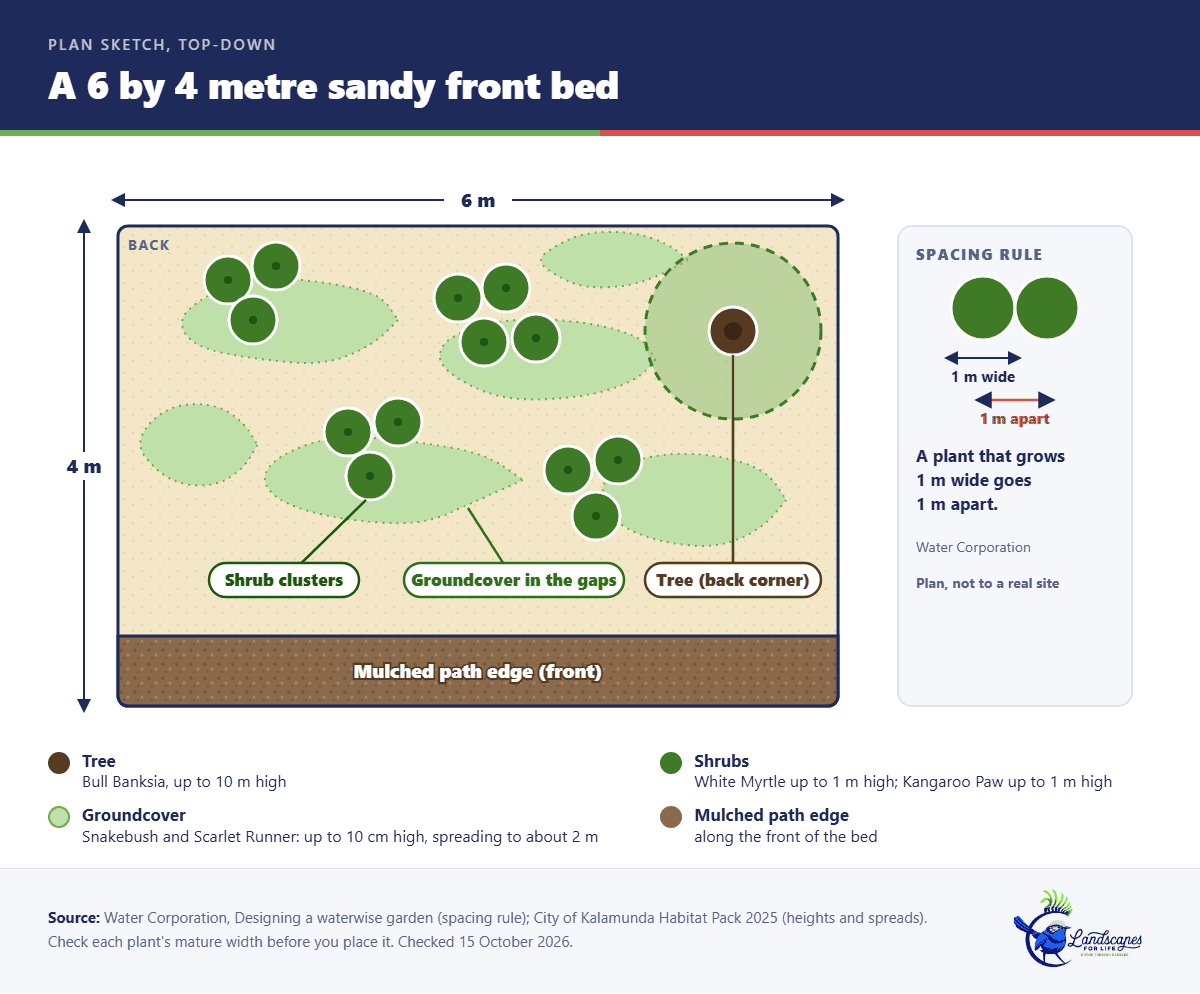
Water Corporation’s free design plans cover native, coastal, Mediterranean and cottage styles, and each comes with a plant-name list to take to a nursery. Use the plan for your region and check each name against the waterwise directory before you buy.
Where to buy local natives in Perth
APACE WA is a retail and wholesale nursery at 1 Johannah Street, North Fremantle. It supplies locally occurring WA flora from the Swan Coastal Plain and Darling Range, which matters if you want plants that match your soil. Its Revegetation Guides, first published in 1992, are organised by vegetation complex, which corresponds to soil type. Find your area on the Suburb Selector map, then use the guide for the species native to it. APACE’s retail nursery serves customers buying 200 plants or fewer, and the nursery’s own page gives its hours as Tuesday to Saturday, 8:30am to 2:30pm.
The Friends of Kings Park propagate their own stock and sell it at quarterly plant sales. Many of the plants are rare or unusual and not stocked by commercial nurseries. Species lists change for each sale, so check the current list before you go.
Frequently asked questions
What is an aus native garden?
In Perth, an aus native garden is a garden built from Australian native plants, and we suggest starting with local WA species. The sources we opened describe local species as adapted to our sandy soils and climate, and Water Corporation says natives suit the climate, flower year-round and attract birds and wildlife.
Do native plants need less water in Perth?
They usually need less once established. Water Corporation’s waterwise rating means a plant needs watering about once a week in summer, or on your rostered days, once it is established in improved soil. Plan for a watering exemption during establishment, and expect the first two summers to be the hard part.
Can I plant natives in sand without adding anything?
Not usually. Water Corporation advises bentonite clay and compost or soil-wetting agents for water-repellent sand, and Perth NRM recommends a wetting agent for the planting hole. Keep the additions light, as Perth NRM advises, and avoid manure-based compost.
Where can I buy native plants in Perth?
APACE WA sells locally occurring WA species from North Fremantle, and the Friends of Kings Park hold quarterly plant sales. Check the current stock before you visit, because species lists change.
Which native plants suit a small garden?
Go for groundcovers and low shrubs. Snakebush and Scarlet Runner spread to about 2 m but stay under 10 cm high, White Myrtle reaches 1 m, and Kangaroo Paw reaches 1 m. Leave Bull Banksia, which can reach 10 m, for larger blocks.
Want a native garden design Perth for your sandy block? Tell us your suburb, the aspect and how much sun the area gets, and get a free quote from our team. We will suggest a plant list from the local sources above.