
Before you buy hedging plants Perth gardens can use, check two things: how tall the plant grows, and whether it is waterwise once established. Plenty of popular hedges fail one or both. This post explains how to read Water Corporation’s waterwise rating, lists the native shrubs a council rates as waterwise, sets out the heights of the screening plants that nurseries sell, and flags where the water claims come from a vendor rather than a public authority. If a hedge belongs in a larger design, our garden designers in Perth can plan the layout with it.
Read the waterwise rating before you buy
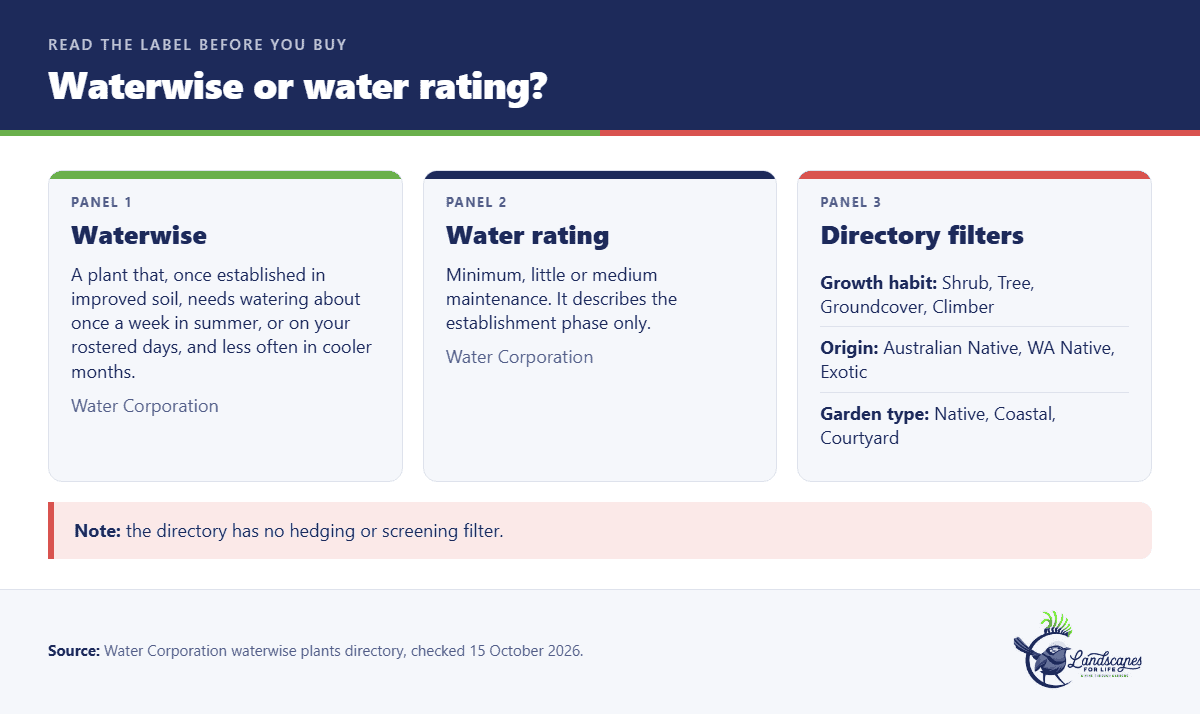
The Water Corporation directory is the authority for Perth. A plant it rates as waterwise needs watering about once a week in summer, or on your rostered days, once it is established in improved soil. Its separate water rating (minimum, little or medium maintenance) describes the establishment phase, so a plant can need more care in its first season and still be waterwise over the long run.
The directory does not have a hedging or screening filter. Filter by growth habit (shrub, tree, groundcover) and check the rating on each plant that looks like a hedge candidate.
Native shrubs a council lists as waterwise
The City of Kalamunda’s Habitat Pack 2025 lists ten native plants. Nine carry a waterwise, drought-hardy rating, and Angled lobelia does not. None of the ten is listed for hedging or screening, so the heights below are our reading of the pack, not a recommendation from the council:
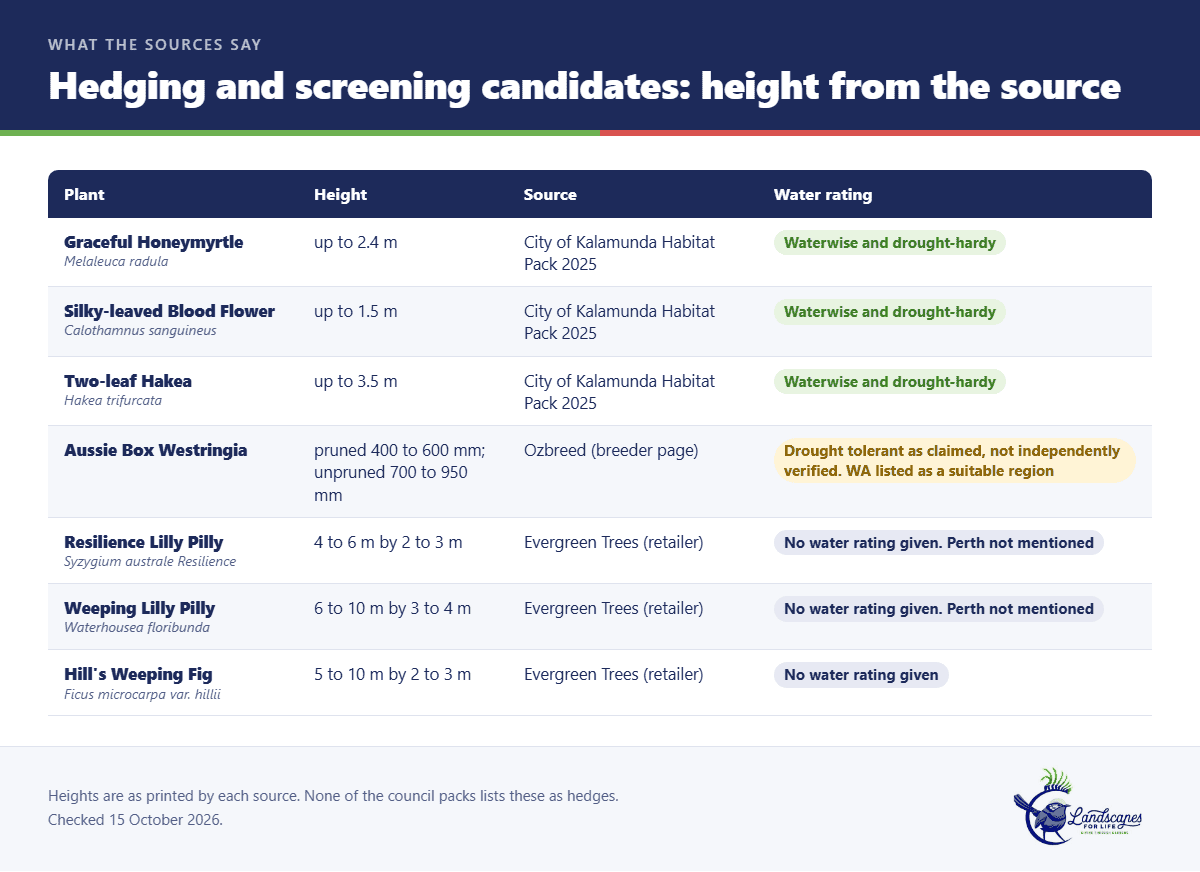
- *Graceful Honeymyrtle (Melaleuca radula)*, up to 2.4 m. The tallest shrub in the pack and the most likely screen.
- *Two-leaf Hakea (Hakea trifurcata)*, up to 3.5 m. Check its form before using it as a hedge.
- *Silky-leaved Blood Flower (Calothamnus sanguineus)*, up to 1.5 m, with red flowers.
These are a shortlist to check in the Water Corporation directory, not a finished hedge plan.
The pack’s stated purpose is to support local fauna, particularly native birds. Its ten plants give food and shelter, and they flower at different times to keep a food supply going through the year. A hedge of these natives does a second job for the birds, which is worth noting if the screen is also meant to look after wildlife.
Vendor and retail hedges: check the water claims
Vendors describe their own plants well, and the claims need checking. The breeder page for Aussie Box Westringia (Ozbreed) gives a pruned height of 400 to 600 mm and an unpruned height of 700 to 950 mm, calls the plant drought tolerant, and says it needs less pruning than other westringias. It lists Western Australia among suitable regions. That is a vendor claim, and the page does not mention Perth.
Lilly pillies need the most care with heights. The retailer Evergreen Trees lists Resilience Lilly Pilly at 4 to 6 m by 2 to 3 m, and Weeping Lilly Pilly at 6 to 10 m by 3 to 4 m. Neither entry gives a water rating or mentions Perth or sandy soil. A nursery search result gave a lower height for ‘Resilience’ (1.5 to 2.5 m), so plan for the taller figure until you have checked the plant itself.
Hill’s Weeping Fig, at 5 to 10 m by 2 to 3 m on the same retailer page, belongs on large blocks only.
Heights decide the hedge
Plant for the height you will have in five years, not the size on the label. A 1.5 m shrub will not screen a two-storey neighbour, and a 6 to 10 m tree needs room to grow. Water Corporation’s spacing rule is the one to follow: a plant that grows one metre wide goes one metre apart.
Pruning also changes the height. The Ozbreed page suggests pruning one to three times a year after flowering, or leaving the plant unpruned in its natural shape. That is the breeder’s advice, so compare it with the nursery’s own guidance.
Water a new hedge through its first summers
Water Corporation’s guidance for new gardens applies to hedges too. A new garden may qualify for a watering exemption during establishment, so the soil stays moist while the roots settle. Once established, a suburban block follows two watering days a week in summer and once a week in spring and autumn. Mulch to a minimum of 50 mm and keep it 50 mm clear of stems, as Water Corporation advises.
Perth NRM notes that after the first two summers, a well-established native should have deep roots and can largely look after itself.
Sand needs the same soil steps for a hedge as for any bed. Perth NRM recommends a good handful of bentonite clay in each planting hole, a single handful of vegetable-based compost rather than manure-based compost, and a liquid wetting agent so water reaches the roots rather than running off the sand. Dig each hole at least twice the pot’s diameter, and set the root ball level with the surface or slightly below, as Water Corporation advises for any planting.
Best plants for Perth gardens: a short list
The best plant for your hedge depends on height, sun and the water rating, so use the list above as a starting point. From the sources we opened, the shortlist is Graceful Honeymyrtle and Silky-leaved Blood Flower, both council-listed and waterwise, with Aussie Box Westringia as a vendor option to verify. The lilly pillies and figs are tall plants with no water rating in the sources we read, so check them in the directory before you buy.
Frequently asked questions
What is the best hedging plant for Perth?
There is no single best plant. Pick by height and by water rating. The council-listed natives in this post are the safest starting point, because each carries a waterwise rating. Check any other plant in the Water Corporation directory before you buy.
What does waterwise mean for a hedge?
A waterwise plant, once established in improved soil, needs watering about once a week in summer or on your rostered days. The rating applies to the established plant. Water Corporation’s separate water rating describes the planting phase, when more care is needed.
How tall will my hedge grow?
Check the mature height on the label or the source, not the height at purchase. The heights in this post are from the sources named in each figure. Lilly pillies and figs can reach 6 to 10 m, which suits large blocks only.
How often should I water a new hedge?
For the first few years, follow Water Corporation’s establishment advice and perhaps apply for a watering exemption during the planting period. Once established, a suburban block follows the roster: two days a week in summer, once a week in spring and autumn.
Who prunes hedges in Perth?
Our pruning and hedge trimming service covers hedges as part of garden maintenance. If you want a hedge planted, shaped or refreshed, get a free quote from our team and tell us the height you want, the suburb and whether the hedge is on a boundary.
Need a hedge planted or an existing one reshaped? Send us your suburb, the length of the run and the height you want, and get a free quote from our team.