
Your front yard is the first thing neighbours and visitors see. In Perth it has to handle summer heat, sandy soil and a council verge that the adjoining owner is usually expected to look after. The best front yard landscaping ideas start with those conditions rather than with a magazine photo. This guide covers kerb appeal, the verge rules you need to check before you plant, low-water planting, paving, lighting and the low maintenance choices that keep a front garden looking good without a weekly job.
Front yard landscaping ideas that start with kerb appeal
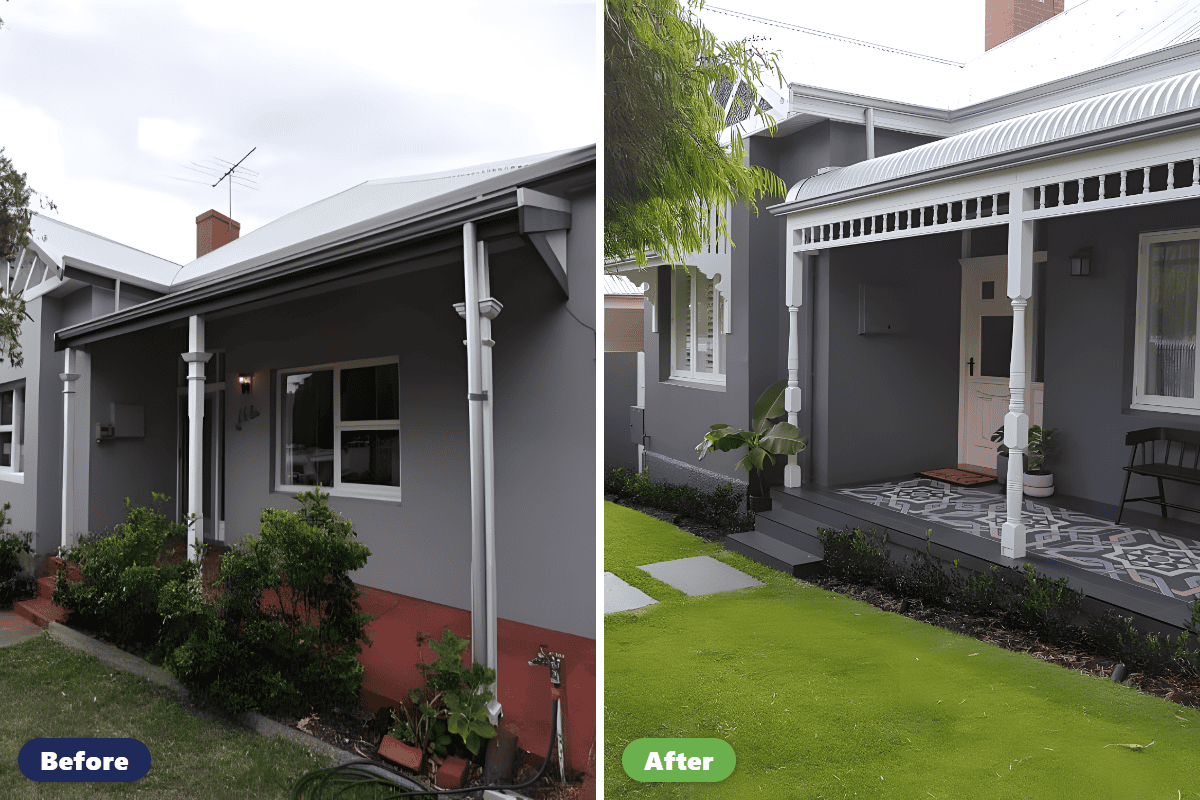
Kerb appeal is what a person sees from the footpath. Three things do most of the work:
- A clear path from the street to the front door, edged so it looks deliberate.
- Planting in layers: taller plants near the fence or the house wall, lower plants along the path, so the house is framed rather than hidden.
- A tidy verge, because neighbours and the council notice it first.
Keep the plant list short. Two or three plant types repeated down the frontage usually look more finished than a dozen single specimens. Keep sightlines open too: plants should not block the house number, the front door or the view of a car pulling out of the drive.
Check the verge before you plant
The verge is public land, but in most Perth suburbs the adjoining owner is expected to look after it. The rules differ between councils, so check yours before you buy a single plant. Here are two examples.
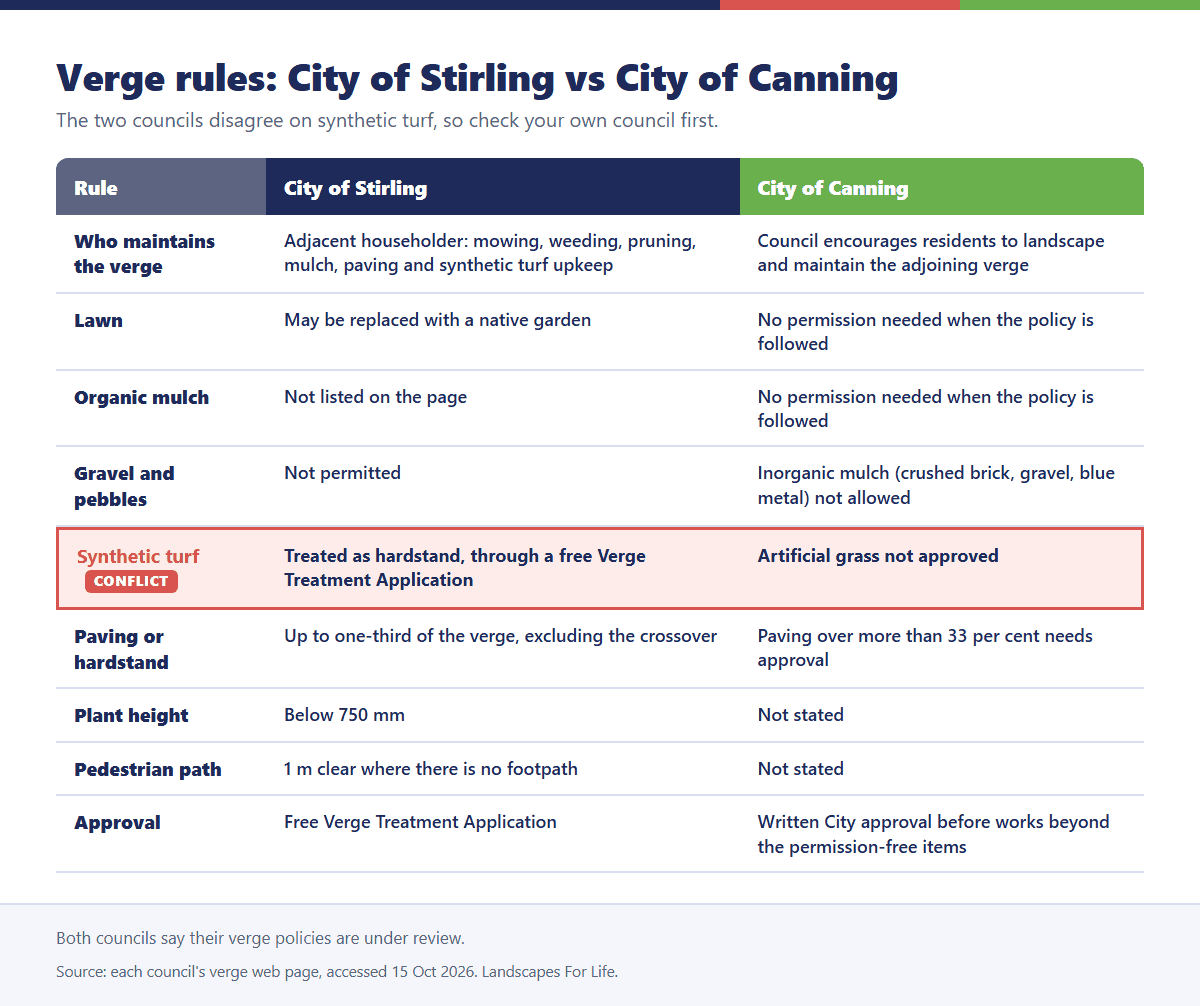
The City of Stirling says the adjacent householder is responsible for upkeep, including mowing, weeding, pruning and the upkeep of any paving or synthetic turf. It allows up to one-third of the verge, excluding the crossover, to be treated as hardstand through a free Verge Treatment Application. Plants must stay below 750 mm, and a pedestrian path at least 1 metre wide must stay clear where there is no footpath. Gravel and pebbles are not permitted. The council does allow a verge lawn to be replaced with a native garden.
The City of Canning is stricter on some materials. Residents do not need permission for lawn, in-ground reticulation or organic mulch, provided its policy is followed, and it prefers waterwise local species. Artificial grass is not approved. Inorganic mulches such as crushed brick, gravel or blue metal are not allowed, and paving over more than 33 per cent of the verge needs approval. Anything beyond the permission-free items needs written City approval before work starts.
The two councils agree on gravel and on the one-third paving limit. They disagree on synthetic turf. Stirling treats it as hardstand that can be approved, while Canning does not approve artificial grass. Figure 1 sets the two side by side. Both councils say their policies are under review, so check the current version on the council website before you start.
Plant for water, not just looks
Water Corporation’s advice on low-maintenance gardens is to group plants by their water needs, which it calls hydrozoning. Put the thirstier plants near the tap and the house, and the lower-water natives and shrubs further out. A front garden planned this way avoids watering the whole bed to keep one thirsty shrub alive.
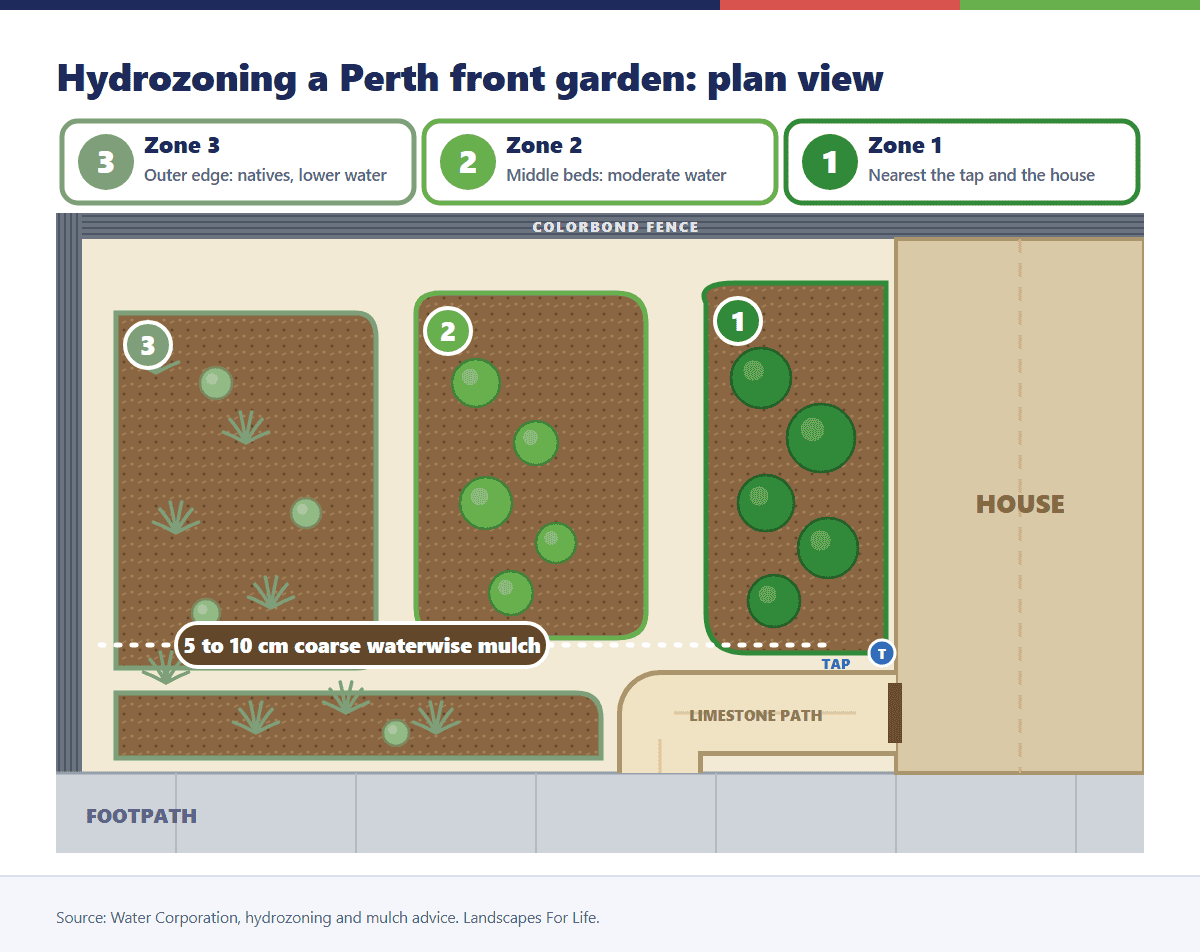
Mulch does more than tidy the bed. Water Corporation recommends 5 to 10 cm of good waterwise mulch across the surface, and says a generous layer can help save up to 20 per cent of water in the garden. Choose a chunky, coarse mulch. Water Corporation says coarse mulch saves more water than soft, fine mulches such as straw and lucerne.
Sandy soil needs help before planting. Water Corporation says sandy soil has low water and nutrient holding capacity, and that sandy soils can repel water. Its advice is to mix organic matter through the top 30 cm of soil before planting a new garden, ideally in autumn or spring. Add a wetting agent and water it in until it foams.
Watering is part of the same plan. Sprinklers in Perth run only on your rostered watering days, and only once, before 9am or after 6pm. Water Corporation’s lookup uses your street number and postcode to tell you which days apply.
Limestone and paving
Paving gives a front yard its hard edges and a usable path to the door. Paving and paths are part of the residential landscaping we do, so talk to us if you want the path and entry laid out as part of the whole front garden.
Keep the verge limits in mind. If part of your verge is paved, the one-third or 33 per cent limit applies to the verge, not to the whole front garden. A front yard with more paving than planting can look hard and hold more heat, so most people end up with a mix. The mix is a design choice rather than a rule.
Light the front of the house
Lighting makes a front garden usable after dark. Start with the path and the front door, then the entry planting and the house number.
Front yard low maintenance landscaping: planting and upkeep
Front yard low maintenance landscaping usually means fewer lawns, a mulched bed with plants that stay near their natural size, a path edged once and irrigation set to the roster. A front lawn is often the heaviest part of the job. Stirling’s guidance allows a verge lawn to be swapped for a native garden, which is one of the simplest ways to cut the work.
Plants that grow to their natural size need less pruning than plants you keep shaping. Read the mature height and width on the label before you plant near the fence, the path or the meter box. Each lawn strip also adds mowing, edging and watering to the weekly list, so one or two lawn-free beds are often the lowest-effort option.
Frequently asked questions
How much does landscaping cost in Perth?
Every job is quoted on site, and quotes are free. Call us on 0429 922 446 and we will give you a price for your block.
Do I need a permit for landscaping in WA?
It depends on what you build. Check with your council before you start, because the verge may need council approval. A retaining wall needs a building permit when it holds back more than 500 mm of ground above natural ground level. The City of Cockburn sets out this threshold and says a permit can be needed at any height if the wall is linked to other building work or protects land.
Can I pave part of my verge in Perth?
Usually yes, within limits. In Stirling, up to one-third of the verge can be treated as hardstand through a free application. In Canning, paving over more than 33 per cent of the verge needs approval. Check your own council’s rule before you order materials.
Do you do design and construction?
Yes, we do garden design Perth and residential landscaping Perth, including plant selection and installation, paving and paths.
How long does a front yard landscaping job take?
It depends on the scope, the access and the weather. Call us on 0429 922 446 and we will talk through your block.
Ready to plan your front garden? Call us on 0429 922 446 or get a free quote. Tell us how you use the space, what the verge looks like and the look you want, and we will work from there.