
A low-maintenance garden in Perth comes down to three things: plant choice, mulch and watering. Water Corporation’s guidance for Perth says the same thing in its own words: pick native and hardy plants, group them by how much water they need, and mulch them well. This post sets out front and back yard ideas that follow that advice, the mulch, watering and wetting agent numbers from Water Corporation, and a groundcover shortlist from a council pack. Where a source is a magazine or a vendor, we say so.
Start with plant choice
Water Corporation’s low-maintenance guidance makes plant choice the first decision. Hardy or native species suited to Perth’s climate are the most successful, and the page points to its waterwise plants directory for the detail. In the directory, you can filter by garden type, including Native, Coastal, Courtyard, Cottage, and Verge, and by growth habit, such as shrub or groundcover.
The directory defines a waterwise plant as one that, once established in improved soil, needs watering about once a week in summer or on your rostered days. Build the garden from those plants first, then add anything thirstier in its own zone.
Front yards: structure, groundcover and one feature
A front yard does well with structure, a few repeated plants and one feature. A Federation home in an older Perth precinct, profiled by Homebeautiful in August 2023, shows how this looks in practice. The designers, Naturescape Creative, chose trees that would not need much maintenance, used rich, well-irrigated soil before planting, and filled the beds with flowering and foliage plants, including blue salvia, forest pansy trees, magnolias, viburnum and liriope. The article gives no numerical maintenance figures, so the point is the planting pattern, not a schedule.
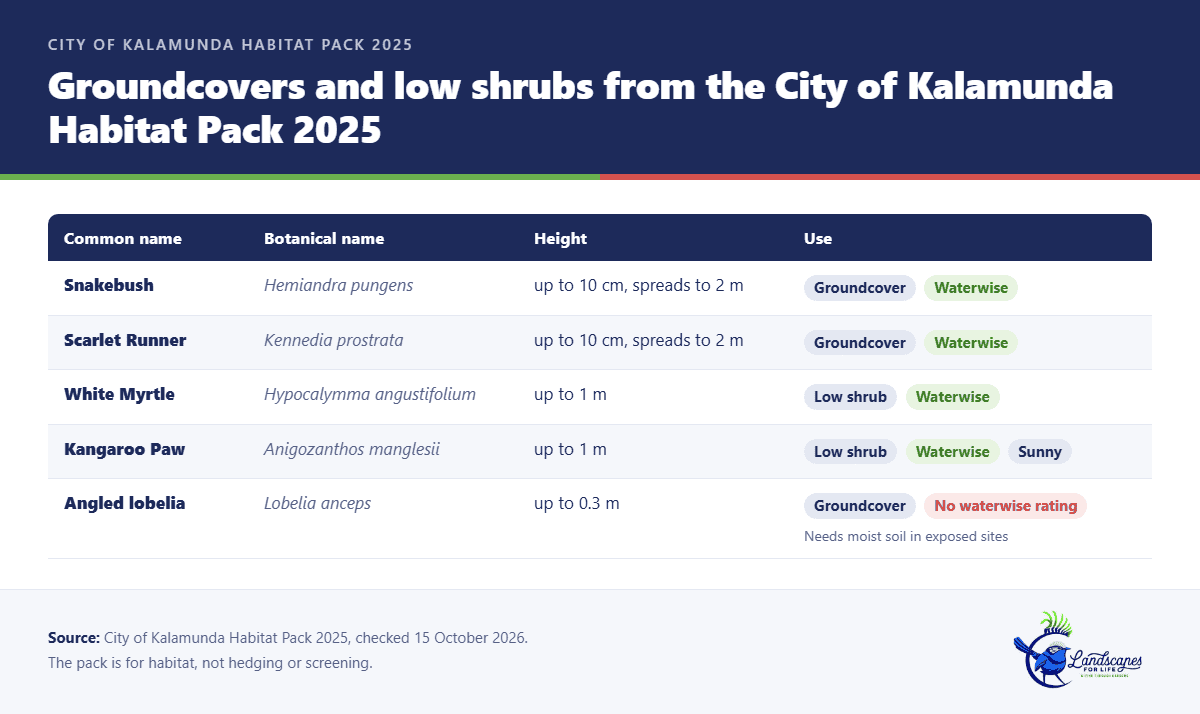
Groundcover fills the gaps between shrubs. The council list in the table below includes two groundcovers that spread to about 2 m, and each stays under 10 cm high. The pack is built for local wildlife, particularly native birds, and its ten plants flower at different times to keep a food supply going through the year, so a front bed of these natives also looks after the birds.
Check the aspect before you plant. The pack rates Snakebush, Scarlet Runner and White Myrtle for sun or light shade, so they suit the shadier side of a front bed. Kangaroo Paw is listed as sunny only, so it belongs on the full-sun side. Angled lobelia is the one that suits sun or shade, but it needs moist soil in exposed sites.
Keep the palette simple. A few plant types, repeated through the bed, read as tidy. That is our design advice, not a figure from the sources.
Back yards: group the water, shrink the lawn
The back yard is where water use adds up, so group the plants by how much water they need. Water Corporation calls this hydrozoning, and it advises keeping high-water areas, such as a vegetable patch, in their own zone.
Complete Home’s coastal Perth makeover shows the approach in a back yard. The owners installed an irrigation system, and the planting uses plants the article calls water-wise, including Liriope gigantea, yuccas, agaves, Dianella ‘Little Jess’ and Metrosideros ‘Fuji Fire’. A greywater system is planned to irrigate the plants later, which the article describes as a separate step.
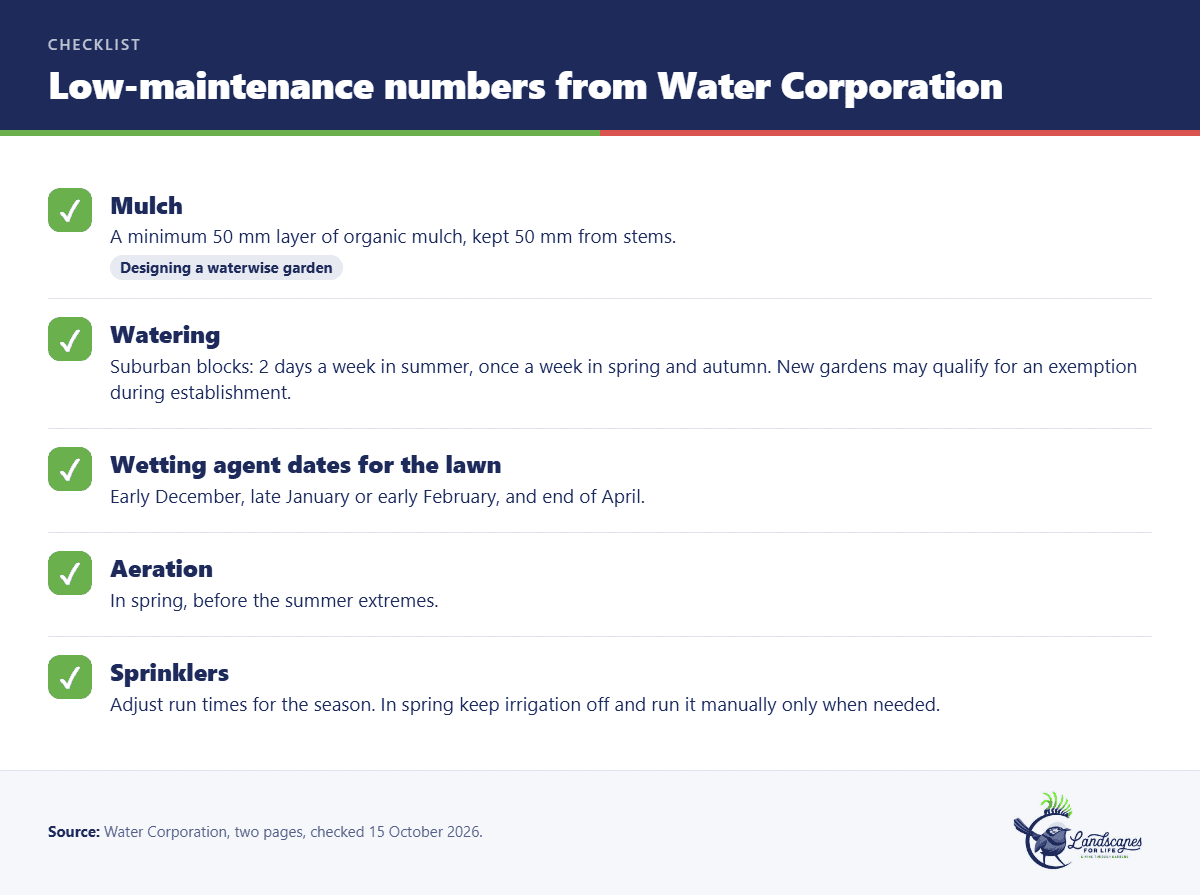
If the lawn stays, keep it easy. Water Corporation advises checking the irrigation with catch cups for even coverage, and applying a wetting agent with a soil moisture retainer at three set times: early December, late January or early February, and the end of April. Aerate in spring, before the summer extremes, so the wetting agent can reach the roots.
Watering and mulch: the numbers that keep upkeep low
Mulch is one of the simplest steps in the garden. Water Corporation’s low-maintenance page recommends a “chunky mulch” to protect the garden from the sun. Its design guidance sets the depth: at least 50 mm of organic mulch, kept 50 mm away from stems, and up to 500 mm from tree trunks.
Watering is the second number to get right. For a typical suburban block, Water Corporation’s guidance is two watering days a week in summer and once a week in spring and autumn. Rainfall in Perth has fallen about 20 per cent since the 1970s, according to the same low-maintenance page, and Perth households use more than half their total water on gardens. That is the reason to plant for Perth’s rainfall rather than against it.
Seasonal sprinkler checks
Water Corporation’s advice on sprinklers is seasonal. Change the watering as conditions change. In spring, keep irrigation switched off and run it manually only when needed. Check the system for leaks and blockages each season, and use catch cups to confirm the coverage is even, so there are no dead patches and no urge to overwater. Set the run times to suit the type of sprinkler you have, as Water Corporation advises. A weather-smart controller can adjust watering automatically if you want less to remember.
Frequently asked questions
What makes a garden low maintenance in Perth?
Three things carry most of it: plant choice, mulch and watering. Water Corporation’s waterwise rating shows which plants need the least water once established, and its mulch and watering numbers show how to keep them that way.
How often should a garden be maintained?
Water Corporation gives timing points rather than a fixed schedule. Apply the wetting agent in early December, late January or early February, and at the end of April. Aerate in spring. Check the sprinklers each season, and adjust run times for the weather. Our low-maintenance garden care plans can carry those jobs for you.
Which plants need the least care in a Perth front yard?
Groundcovers and low shrubs from the council list in this post are the simplest starting point, because each carries a waterwise rating. Check any other plant in the Water Corporation directory before you buy, because the directory gives the rating for each plant.
Can a low-maintenance garden still have a lawn?
Yes. Water Corporation’s lawn advice is about the upkeep: check the irrigation, apply the wetting agent on its dates and aerate in spring. The source does not give a lawn share of the garden or of household water, so a smaller lawn is a judgement call, not a sourced rule.
What does garden maintenance include?
For a low-maintenance garden, Water Corporation’s guidance sets out the recurring jobs: check the irrigation for leaks and blockages each season, apply a wetting agent on its dates, aerate the lawn in spring, keep the mulch at 50 mm, and run the sprinklers manually in spring only when needed. The Homebeautiful front garden above follows the same planting logic, with trees chosen to need little work. If you want a front or back yard planned around those jobs, ask us through our garden design Perth service.
Want a low-maintenance garden planned for your front or back yard? Tell us your suburb, the size of the area and how much sun it gets, and get a free quote from our team.