
Small backyard landscaping ideas matter more in Perth every year, because many new blocks are smaller than the ones older homes were built on. A courtyard or a narrow backyard has to do more work with less room: fewer features, clear zones and planting that earns its place. This guide covers why yards are shrinking, how to zone a small space, how to use vertical and screening plants, the synthetic turf question, and how to start on a budget with soil and mulch.
Why many Perth yards are getting smaller
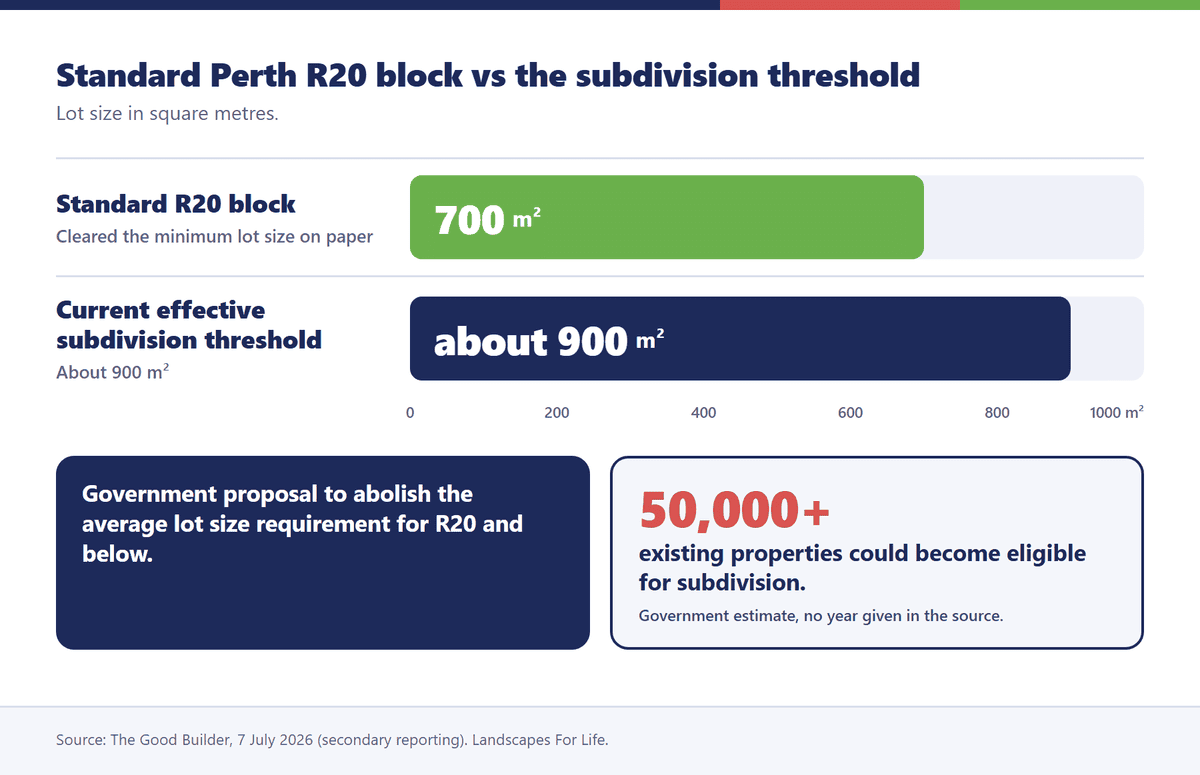
The lot size figures are moving. A July 2026 report in The Good Builder describes a standard R20 block of 700 square metres that “cleared the minimum lot size on paper” but fails the average lot size test. It puts the current effective subdivision threshold at around 900 square metres. The article reports a State Government proposal to abolish the average lot size requirement for R20 and below, and an estimate that more than 50,000 existing properties could become eligible for subdivision. The article does not name the government document behind those figures, so treat them as a starting point.
Curtin University’s infill commentary adds a different angle. It says current infill often splits one large lot into two and builds two large houses, which adds only one dwelling, and that housing stock is still dominated by large detached homes. A small yard in Perth can therefore come from a new subdivision, or from an older block where a big house now fills most of the space. Either way, the question is the same: how to make the outdoor space work.
Small backyard landscaping ideas: zone the space first
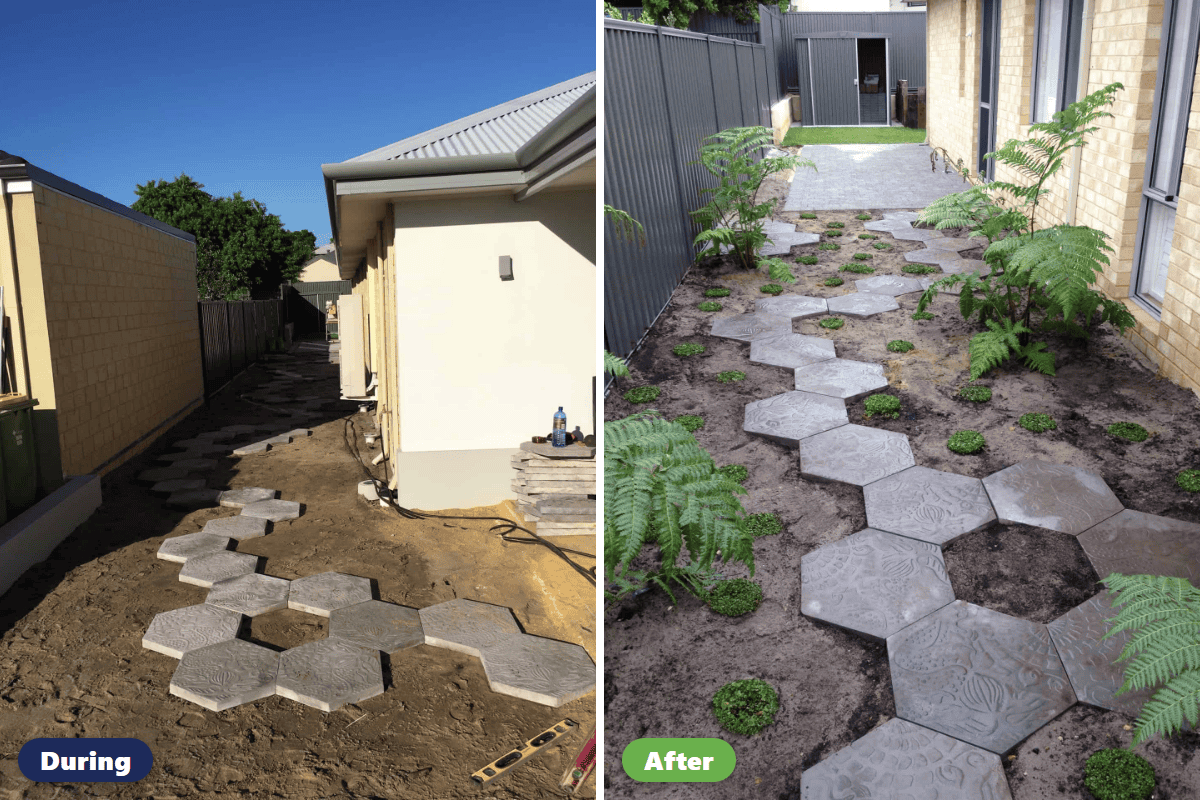
Before you choose a plant, decide what each part of the yard is for: where people sit, where children play, where the bins and the clothesline go. Mark those zones on paper. A small yard feels larger when each zone has one job. A path or a change of surface can separate zones without a wall. Lawn can flow into paving at the edge of the dining area, so the two spaces read as separate without any extra structure.
Measure before you draw. Note which corners are shaded and when, where the tap and the power points sit, and which wall takes the hardest afternoon sun. Plant and seat for the hours you actually use the space, not for the hours you imagine.
Zoning helps with water too. Water Corporation advises grouping plants by how much water they need, which it calls hydrozoning. In a small yard, that means the thirsty plants and the lawn sit close to the tap, and the lower-water plants go to the edges, where they need less attention.
Use vertical and screening plants
When floor space is tight, grow up. Climbers on the fence, a narrow bed along the boundary and a cluster of pots by the back door all add greenery without taking up a path. Screening plants along a boundary also give privacy in a small yard, where a neighbour’s window may be close.
Check the mature height and spread on the label before you plant near a fence, a path or a wall. A plant that outgrows its space needs pruning every year, which is the opposite of low maintenance. Before you plant against a fence, check that the fence is sound and that you can reach the plant to prune it from your side. A climber pulling at a loose panel adds cost later.
Synthetic turf or real lawn in a courtyard?
In a private courtyard, the choice comes down to how you use the space and how much work you want. Real lawn needs water on your rostered days and mowing. Synthetic turf needs neither. The rules change if the turf is on the verge. The City of Canning does not approve artificial grass on verges. The City of Stirling treats synthetic turf as hardstand that can be approved through an application, within the one-third limit. Check your council before you lay anything on the verge.
We install synthetic turf as well as lawn and turf, so we can talk through both options for your courtyard.
How much paving is enough?
Paving suits paths and entertaining areas, but a courtyard paved edge to edge can look hard and leave no room for planting. Leave at least one planted edge along a fence or a wall.
Mulch is the simplest way to cut water loss in a small bed. Water Corporation recommends 5 to 10 cm of good waterwise mulch across the soil surface, and says a generous layer can help save up to 20 per cent of the water in the garden. Choose a chunky, coarse mulch, which saves more water than fine mulch.
Start on a budget with soil and mulch
If the budget is tight, start underneath the surface. Water Corporation says sandy soil has low water and nutrient holding capacity. Its advice is to mix organic matter through the top 30 cm before you plant a new bed, ideally in autumn or spring. A wetting agent helps sandy soil take up water, and it should be watered in until it foams. These are low-cost steps, and they make each later plant work harder for less water.
Then add mulch, then plant. Pick a few plants that suit each zone and repeat them. Add the hard landscaping in stages as the budget allows.
Keep what already works. A healthy tree, a sound fence or a usable slab can stay, which keeps the first stage small. Make a list of what you are keeping before you price anything, so the quotes you get cover only the work you actually need.
Frequently asked questions
How much does a small backyard landscaping job cost in Perth?
Every job is quoted on site, and quotes are free. Call us on 0429 922 446 and we will give you a price for your block.
How long does a backyard landscaping job take?
It depends on the scope and the weather. Call us on 0429 922 446 and we will talk through your yard.
Do you do design and construction?
Yes, we do small garden design Perth and residential landscaping Perth, including plant selection and installation, paving and paths.
Do I need a permit for a retaining wall in a small yard?
A retaining wall needs a building permit when it holds back more than 500 mm of ground above natural ground level. Height is measured from natural ground level and includes any buried part. A wall of any height can need a permit if it is linked to other building work or protects land. The City of Cockburn sets this out on its retaining wall page. Small yards often have a wall at the boundary, so check before you build.
What plants suit a small courtyard in Perth?
Start with waterwise local species, which the City of Canning prefers on its verge, and group them by water need. Plant selection and installation is part of our service, and we also rejuvenate Perth’s sandy soil before planting.
Planning a small yard? Call us on 0429 922 446 or get a free quote. Tell us how the space gets used, and we will start with that before we talk about plants.